
09 December 2015


03 September 2015
James Bond - From Russia With Love - That's Hitchcock You Hear Coming
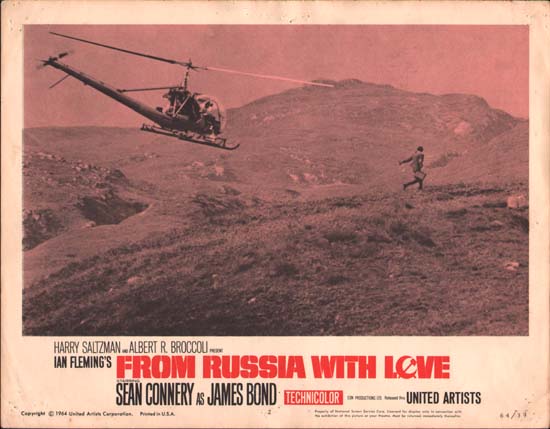
When the gypsy catfight turns into a fiery western gun battle, (complete with flaming arrows,) and ends with James Bond bedding both the gypsy women, I was almost going to bail on From Russia With Love.
I’m glad I didn’t.
The second James Bond film fills almost all of the template that would endure for decades, though much of it was already there in Dr. No, the very first outing for 007. In this movie we get a briefcase with all sorts of gadgets in in it, we get some henchmen for the evil genius villain, credits projected onto scantily-clad dancing women, and a pre-credit sequence. This is a complete Bond package.
But, oh, how silly the movie gets, and how fast it gets there.
29 August 2015
The Search for General Tso - Food reveals our history - Good and bad

A fifth generation descendant of General Tso himself is flattered and hopeful that the General's name is so well known throughout the United States, but sad that it has no real connection to the incredible historical feats of the actual General, a hero of Hunan province in China.
Meanwhile, an influential chef, who once fled from Hunan to Taiwan, is impressed with how much Chinese cuisine, (inspired by the wonderful culinary traditions of his homeland,) is consumed in America, but regrets about how Westernized those foods have become in the process.
In a simple quest to find the origin of the ubiquitous dish of the documentary's title, the filmmakers end up telling the story of American and Chinese relations including geopolitics and immigration. They travel across the world in their inquiry, speaking to foodies, restauranteurs, chefs and historians.
The story of the multi-billion dollar Chinese food industry in the United States is, as one of the talking heads in the film puts it, "the story of the Chinese in America." It was birthed out of draconian policies put in place to suppress the Chinese population who had come to this country in droves to gain employment during the railroad boom.

Chinese, who legally could not gain any type of employment, started laundry services and restaurants as a way to survive. And to assimilate.
There are Chinese restaurants in some very remote places in the country and the filmmakers go to them to hear their stories. And all of them include details of how they adjust their menus to the tastes of their regional American customers. A very common response from the Chinese who own these restaraunts: "The Chinese food Americans like is very bland."
The story takes a lot of twists and turns through history and opens up some questions that stuck with me.. For instance, one commentator notes that fine Chinese food takes just as much labor and craft as French food, but Americans will not pay premium price for Chinese food.
Also, there is a section of the film exploring a massive network of social organizations that help staff and support Chinese food establishments across the country.
The pace of the film is leisurely and methodical and it doesn't have any real surprises or urgency that will keep you hanging on the edge of your seat. In fact, it feels like the final answer to the film's central question was known way before they even started rolling cameras.
But it is always interesting and supported by fun graphical interludes. And as much as it is the inspiring story of people coming from nothing and building successful businesses and a whole industry, it's also a shameful look at our how our country's xenophobic policies made it very hard on them.
26 August 2015
Stay away from reviews of The Gift! Especially the New York Times one

Having just posted my own review of the thriller The Gift, my advice seems self-defeating. But I mean it.
The Gift is a thriller that unfolds organically and takes some nice twists and turns. It subverts some genre conventions and toys with others. It is best experienced with as little information as possible upfront.
I had seen the trailer for the film back before the movie was released and took note of it simply because Jason Bateman seemed to be playing a more dramatic role, and because it included Rebecca Hall, who makes every movie better. However, at least from the trailer, it appeared that this was a predictable stalker genre film about somebody tormenting a couple in their new home - Pacific Heights, anybody?
As the film gained some positive buzz on Twitter and racked up an impressive score on Rotten Tomatoes, I was very intrigued. And, after seeing it this past weekend, I began to check out some reviews.
Wow. The first one I read - the New York Times review by Stephen Holden - gave away way too much. Several others did as well.
Now, I'm sympathetic to reviewers trying to hit a word count, and I'll admit that Mr. Holden doesn't give away any major spoilers, but I would have had considerably different experience if I had read that review before seeing the film.
I did find many writers doing a pretty good job at critically discussing the film and performances, and taking care to weave around things just enough to not give away the game.
Intrigued, I tried my hand at writing a little review of the film myself, and it wasn't easy. I ended up concentrating on the style and some of the visual motifs, but my review seemed anemic and vague.
I'm not a spoiler cop at all. I think the idea of spoiler warnings has gone a little too far in recent years. But this is one case where I find myself putting on the uniform and sounding the alarm.
The Gift is a good movie and deserving of its current 92% on Rotten Tomatoes. I don't usually do this, but I'd advise you to just trust that aggregate score, skip reading the reviews, and check out the film while it is still and theaters. Hurry before it gets spoiled for you.
25 August 2015
Review -The Gift (2015) - Through the Glass, The Past Will Find You

There is a lot of glass in The Gift, Joel Edgerton's debut as a director and writer. Windows, wine goblets and mirrors reflect, refract and act as invisible barriers. The opening shots are of an empty modern home, sunlight streaming through its floor-to-ceiling windows.
Simon (Jason Bateman) and his wife Robyn (Rebecca Hall) are checking it out as possible new home as Simon has landed a big new job with an area start-up. The house is bright and has a spectacular view, but as they close the deal and begin to set up their happy home, you start to notice how little privacy all that transparency provides.
And it is through another glass that we first view Gordon, an unassuming looking man with a goatee and dressed casually. He is in the corner of the frame, observing Simon in a store, picking some things out for the new house. After an introduction Simon vaguely remembers Gordon as "Gordo."
It seems they went to high school together. While the exchange is not awkward or weird, it is just slightly unsettling. Simon seems to just barely remember Gordo, but Gordo seems tentative, as if Simon should remember him very well.

Before we know it, Gordo is appearing quite a bit at the house, politely bearing gifts and helping them get their new home up and running. He appears in windows, looking in, as if he is searching for something. Robyn, feeling the stress of transitioning from running a design firm to trying to start a family, sort of welcomes Gordo in the midst of all of this, or at least feels bad for him in some way.
However, Simon is getting less patient and starts to view Gordo as mentally unstable. He thinks his high school acquaintance may be imagining that they were better friends than they were, or worse, Gordo could be developing an unhealthy obsession with Robyn.
And after reading all of this, you may think you know where this is going. You don't, or at least I didn't. The story, written by Edgerton, makes all the right feints to make you think you are a step ahead, but then it jukes you. Smartly keeping the focus on psychological mind games, Edgerton keenly shapes his themes of memory, the past, privacy and secrets.

At one point, Gordo asks Simon, who works for an Internet security company, what he thinks of the NSA spying scandal. We are always being watched and analyzed, yet we can sometimes keep secrets of the past, even from our most intimate partners. By the end of the film, the glass walls of the house will provide no safety for the couple.
The Gift is one of those movies that is hard to discuss without spoiling it too much. If you are up for a thriller, and willing to take the ride, you'll be rewarded by the turns of the plot, but also the nice visual motifs that Edgerton layers within the film.
24 August 2015
James Bond - Dr. No - Minimalist Template for Grandness and Goddesses

Late in Dr. No, the 1962 spy thriller that introduced moviegoing audiences agent 007, James Bond (Sean Connery) is sneaking through a network of large ventilation shafts, some of which release torrents of water and some of which are extremely hot. He comes to intersections and he has to make a quick decision to go left or right, up or down.
The scene is almost avant-garde by today’s action standards. It is wordless, the only sounds are far off rattles and clangs echoing in the shafts. Bond makes his way through the tunnels and actually into the heart of the command center of Dr. No, who is the villain of this first entry into the film franchise. The climax of the film starts to ramp up, when, finally, we hear something that has been absent for a long time: the score.
Indeed, this long stretch of the film has proceeded without any music backing it. Today, we are used to heavy, and sometimes quite good, compositions for action films. So, it is a little conspicuous to go without it for so long in an action thriller. However, the editing and the direction come together in a way that definitely builds tension towards the final confrontation.
19 January 2015
Coverage - What I've Been Watching
Snowpiercer

I missed the party, or, I guess, the train on this one. Currently hovering at over 90% on Rotten Tomatoes and on many critics Top Ten lists for 2014, this dystopian sci-fi action thriller slows down the further up the train its rebel dregs of society get. The filmmaker doesn't seem to know what do as the rag-tag group advances, so the movie starts stretching out action sequences and recycling well-worn tropes of the many genres it is pulling into its orbit. All the actors, especially Tilda Swinton seem game for the ride, but the film never gets back on track after she departs.
Coherence

In the spirit of Primer and the under-seen mind-bender Triangle, this low budget ensemble piece starts as a mumblecore-type dinner party movie, like we've seen a hundred times in the past eight years. However, a passing comet starts to affect the guests in strange ways. Very interesting through most of its running time, it also sticks the landing better than many other films of its type.
In Fear
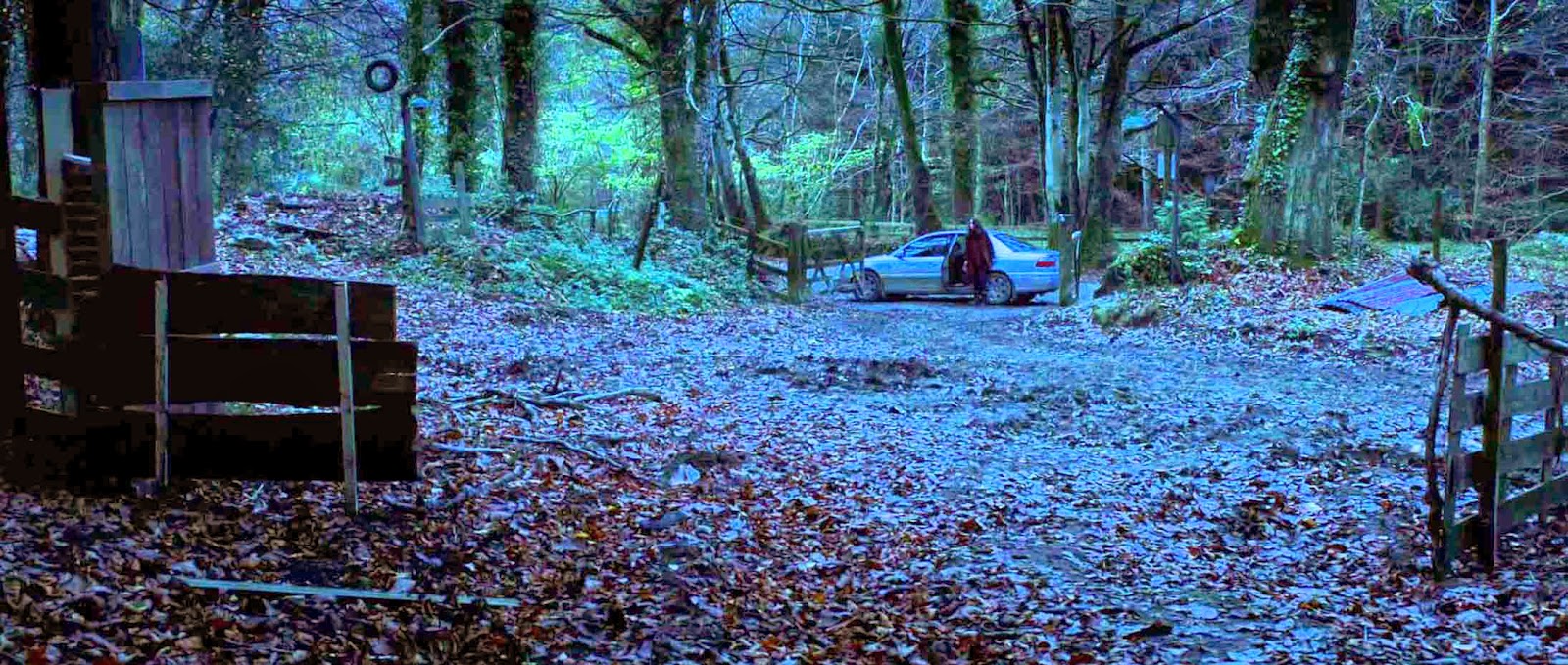
The desolate English countryside and the narrow, tree-lined woods, through which this couple have to navigate as night falls and strange events begin to happen, is the best character. The atmosphere is creepy and the maze of trails get more tight and claustrophobic, but the film falters as it runs into its second half, only temporarily picking up a little jolt from the performance of an added character with a twisted smile and a glint in his eye. Once the usual climactic beats kick in, the film gets less and less interesting.
The Babadook

The Babadook promises a lot with its slow buildup and its gambit of saddling the protaganist, a widowed single mother, with a kid prone to flights of maddening screaming or fits. Essie Davis, in a bravura performance that leaves everything on the table, screams at the child, "why can't you just be normal!" We feel for her, deeply. While the introduction of a sinister, Edward Gorey type pop-up book fills the dark corners of our mind with horrifying possibilities, the film abandons this innovation to give us warmed over homages to moments from other horror classics, almost like ticking off boxes: The Exorcist, The Shining, Nightmare on Elm Street, The Grudge, etc. It becomes apparent that the filmmaker is less interested in making a truly terrifying film, and more insistent on making sure that we get the deeper meaning, that we know that we're not just getting a horror flick, but a story with themes. As a harrowing story of the closed world of a damaged mother and son, the movie is solid. There are genuine creepy moments and some interesting sequences, but don't come for The Babadook, instead this is Essie Davis's film from the first frame. Her performance leaves nothing behind and she commits to every single moment.
The Unknown Known

Errol Morris is a national treasure, and this interview, his second with a U.S. Secretary of Defense who presided over a complicated quagmire of war, is a fascinating chase down a rabbit hole of beauracratic thinking gone wild. Morris and Rumsfeld are actually quite well matched, and Rumsfeld comes off as an amazing performance artist, who has perfected his bit so well that he long ago bought completely into it. I'm not sure you could create a better fictional character to represent the military industrial complex of the Iraq War era. Danny Elfman's score is odd and distracting at points.
I missed the party, or, I guess, the train on this one. Currently hovering at over 90% on Rotten Tomatoes and on many critics Top Ten lists for 2014, this dystopian sci-fi action thriller slows down the further up the train its rebel dregs of society get. The filmmaker doesn't seem to know what do as the rag-tag group advances, so the movie starts stretching out action sequences and recycling well-worn tropes of the many genres it is pulling into its orbit. All the actors, especially Tilda Swinton seem game for the ride, but the film never gets back on track after she departs.
Coherence
In the spirit of Primer and the under-seen mind-bender Triangle, this low budget ensemble piece starts as a mumblecore-type dinner party movie, like we've seen a hundred times in the past eight years. However, a passing comet starts to affect the guests in strange ways. Very interesting through most of its running time, it also sticks the landing better than many other films of its type.
In Fear
The desolate English countryside and the narrow, tree-lined woods, through which this couple have to navigate as night falls and strange events begin to happen, is the best character. The atmosphere is creepy and the maze of trails get more tight and claustrophobic, but the film falters as it runs into its second half, only temporarily picking up a little jolt from the performance of an added character with a twisted smile and a glint in his eye. Once the usual climactic beats kick in, the film gets less and less interesting.
The Babadook
The Babadook promises a lot with its slow buildup and its gambit of saddling the protaganist, a widowed single mother, with a kid prone to flights of maddening screaming or fits. Essie Davis, in a bravura performance that leaves everything on the table, screams at the child, "why can't you just be normal!" We feel for her, deeply. While the introduction of a sinister, Edward Gorey type pop-up book fills the dark corners of our mind with horrifying possibilities, the film abandons this innovation to give us warmed over homages to moments from other horror classics, almost like ticking off boxes: The Exorcist, The Shining, Nightmare on Elm Street, The Grudge, etc. It becomes apparent that the filmmaker is less interested in making a truly terrifying film, and more insistent on making sure that we get the deeper meaning, that we know that we're not just getting a horror flick, but a story with themes. As a harrowing story of the closed world of a damaged mother and son, the movie is solid. There are genuine creepy moments and some interesting sequences, but don't come for The Babadook, instead this is Essie Davis's film from the first frame. Her performance leaves nothing behind and she commits to every single moment.
The Unknown Known
Errol Morris is a national treasure, and this interview, his second with a U.S. Secretary of Defense who presided over a complicated quagmire of war, is a fascinating chase down a rabbit hole of beauracratic thinking gone wild. Morris and Rumsfeld are actually quite well matched, and Rumsfeld comes off as an amazing performance artist, who has perfected his bit so well that he long ago bought completely into it. I'm not sure you could create a better fictional character to represent the military industrial complex of the Iraq War era. Danny Elfman's score is odd and distracting at points.
09 June 2014

24 May 2014
Godzilla (2014) - Review

Very late in the newest entry in the Godzilla franchise, the giant titular lizard has leveled half of San Francisco, but finds himself only halfway to his goal of defeating his enemies. His massive frame, supported by two impossibly large legs, slumps, and his shoulders droop into a fatigued sigh. It's as if he’s moaning, “ whew, how much more of this?"
"I know how you feel, big guy," I wanted to shout at
the screen.
This monster action movie takes a long time to get the
monsters and then lays on a lot of action late in the game.
The good news is that moviegoers who have an intense
interest in seeing the old fashioned Godzilla fully realized through the best of modern
cinematic technology will come away satisfied. The bad news is that anybody looking for almost anything else will most
likely walk away shrugging.
The original Godzilla film, made in 1954, was birthed in
direct response to incidents involving nuclear weaponry and its effects on the
Japanese people. In director Gareth
Edwards new re-imagining, the premise, involving Japanese nuclear reactors, admittedly
brings up the shadow of the recent Fukishima disaster, but is tossed into the
narrative with less care than a ripped-from-the-headlines Law and Order
episode.
Bryan Cranston, fresh off his
artistic triumph as Walter White in AMC's series Breaking Bad plays a nuclear
scientist living in Japan and running a power plant with his wife played by
Juliette Binoche. Steadily ncreasing tremors
trigger a full meltdown and disaster at the plant, but when we flash 15 years
forward, it seems that the disaster may have been something else entirely. Cranston's scientist, now a loner and estranged from his only son, is sure that the government, which still keeps a strict quarantine on
the area is lying to the public about what really happened.
Guess what? They are! And, like all government operations in these disaster monster movies,
there are tens of thousands of personnel involved in these top secret
machinations. As these things usually
go, the experiments conducted get out of control fast, and soon there is a
prehistoric creature on the loose, and it feeds on nuclear material! This flat-headed, winged creature seems to
be a nod to another famous Japanese monster creation Rodan, and it turns out
that it isn't alone!
You might notice that in my summation of the plot so far I
haven't even mentioned Godzilla. Exactly! Most of the movie's first half is establishing
Godzilla's antagonists, which the U.S. military, in its inimitable fashion,
names the M.U.T.O.'s (Massive Unidentified Terrestrial Organisms.) In truth, the military doesn't seem very
perturbed. In fact, everybody is pretty calm about this impending titanic clash
between a couple of mating MUTOS and now-wakened Godzilla, who seems, for some
reason, incredibly intent on locking horns
with these creatures.
Apparently, Godzilla has risen from the depths in
response to the presence of the MUTO's , seeing them as worthy prey for his
apex predator tastes. This is all according
to a pair of scientists; both are played by the way overqualified duo of Ken Wantanabe and Sally Hawkins. They explain everything with about as much
excitement as the military does. Everything is so matter-of-fact in this film
that it is hard for any suspense to materialize.
In trying to follow the classic formula of indirectly
revealing the monster over time, a technique popularized by Steven Spielberg's Jaws, the
film is infused with aimlessness that even the spectacular destruction of two
major U.S. cities can't redeem. I will
admit that the filmmaker does get off a shot of genuine irony when
Godzilla finally appears full bodied on screen.
 |
| Ken Wantanbe's scientist and David Straithern's Admiral wait around some more. |
But, mostly, we wait.
This is a film in which main characters spend a good amount of time on a
Navy ship, following Godzilla's huge spiked back as it cuts a wake at a comfortable
speed through the Pacific. One exception
is a suspenseful nighttime mission where two soldiers are trying to evade a
lurking MUTO while they maneuver on a high railroad trestle.
Back to the good news, though. Godzilla looks great and moves, well, like a
guy in big rubber suit, and I mean that in the best way possible. When the
gigantic, and I mean gigantic, reptile is pushing the MUTOs around the city, he
seems like a live wrestling bear rather than some sleek CGI creation . He really
is a great technical achievement. It is
pretty thrilling to see the infamous Godzilla roar send ripples through his neck
muscles. The MUTOs, on the other hand, look more like the standard issue creatures that
seem to inhabit summer blockbusters over the last five or six years, although I
do like the way they crack open nuclear missiles and chug the radiation
inside like they were a downing a Red
Bull.
All of this technical magic comes later in the movie, (which
isn't really that unusual for a monster film,) but what is unusual is the way
the human stories are treated so perfunctorily.
Director Gareth Edwards made a small stir with his indie film Monsters
back in 2010. In that film, the
creatures also take their time revealing themselves, but there was much more
suspense built through the growing connection between the two human
protagonists, so that when all hell cuts loose, we're on the edge of our seat.
26 February 2013
Movie Posters - Oh, Heavenly Dog! (1980)
.jpg)
Chevy Chase shares billing with Benji. As a bonus, down at the bottom, above the PG rating, are the following sentences that create a bizarre juxtaposition:

1. "Read the Scholastic Paperback"
2. "See Benji as the August Playgirl Centerfold"
Those were the days, huh?
03 January 2013
10 Best Movies of 2012
This year, I decided to try my hand at making a list of what I thought were the best films of the year. I tried to limit myself, as most critics do, to movies screened or released in 2012. I also tried to limit the list to films I saw in theaters.
I haven't seen some films (Zero Dark Thirty, Django Unchained, etc.) that appear on many other end of year lists. However, I also have seen most of the films (Lincoln, etc.) that appear on those lists, but do not appear on mine.
Here is my Ten Best of 2012.
1. The Imposter

I can't remember the last time I watched a movie with so much of my time spent thinking, "No. No, it can't be. What? Oh, my god." It also contains one of the most incredible criminals every put on film. If he was a fictional creation, you wouldn't buy him.
2. The List

A fascinating documentary about an interesting hero. He has dedicated his life to saving from retribution the Iraqi's who helped coalition forces during the Iraq war. Even with generals and politicians behind his crusade, the wheels of bureaucracy threaten to grind his righteous mission into dust.
3. Headhunters

Over the course of this brisk Norwegian thriller, you will laugh, cringe and shriek at the gathering misfortune of an arrogant art thief. He is the kind of character you would usually hate in another movie, but from the very opening words and images, he won me over with his unusual predicament, which only gets worse.
4. The World Before Her

The filmmakers follow two contrasting training programs : The preparation for the televised Miss India pageant and the boot camp style indoctrination of the young girls of a radical religious/political movement. If the two forces currently battling for global supremacy are celebrity entertainment culture and militant conservative religiousness, then I can't think of movie that better juxtaposes and examines the two.
5. Argo

This movie is labeled by many as a thriller, but it is actually a heist movie. Affleck's direction is pretty marvelous and doesn't call attention to itself. I was gripped throughout, even during the over-the-top, apparently embellished ending of this real life tale, despite, I hate to say this, Affleck's miscasting of himself in the lead.
6. The Master

A tough film to include since I think it ultimately falls away, and apart. However, it was engrossing and hypnotic. The 70MM print I watched left me with indelible cinematic memories. Joaquin Phoenix's Freddie Quell may go down as a great movie character. If only Hoffman's Lancaster Dodd was more equally realized.
7. The Queen of Versailles

Though the last third lags a bit, this whirlwind ride down the financial collapse of 2008 is almost a perfect farcical creation. The larger than life characters, trying to keep the lights on and the dog poop off the carpet of their mansion, are so warped that they become a funhouse mirrors into which we cry at our own distorted reflections.
8. 21 Jump Street

All right. This was a very funny movie. It dispensed with the usual re-make/sendup strategy and tried to make us laugh on its own terms. The best part was that almost every single actor in it, even some well-placed cameo players, seemed to get what was happening.
9. Silver Linings Playbook

When was the last time you saw Robert Deniro as vulnerable as he is in this film? A rediscovery of his immense talent is just one of the joys of this romantic comedy by way of recovery melodrama. It is an odd hybrid for sure, but David O. Russell just about manages to pulls off with heart, pain and only a modicum of the schmaltz and pretension that accompanies similar efforts.
10. A Separation

I admit, it is a bit of a cheat on my list, A Separation was released at the very end of 2011 in the U.S., so most of us didn't see it until 2012. However, it is, quite simply, as good as you have heard it to be.
I haven't seen some films (Zero Dark Thirty, Django Unchained, etc.) that appear on many other end of year lists. However, I also have seen most of the films (Lincoln, etc.) that appear on those lists, but do not appear on mine.
Here is my Ten Best of 2012.
1. The Imposter

I can't remember the last time I watched a movie with so much of my time spent thinking, "No. No, it can't be. What? Oh, my god." It also contains one of the most incredible criminals every put on film. If he was a fictional creation, you wouldn't buy him.
2. The List

A fascinating documentary about an interesting hero. He has dedicated his life to saving from retribution the Iraqi's who helped coalition forces during the Iraq war. Even with generals and politicians behind his crusade, the wheels of bureaucracy threaten to grind his righteous mission into dust.
3. Headhunters

Over the course of this brisk Norwegian thriller, you will laugh, cringe and shriek at the gathering misfortune of an arrogant art thief. He is the kind of character you would usually hate in another movie, but from the very opening words and images, he won me over with his unusual predicament, which only gets worse.
4. The World Before Her

The filmmakers follow two contrasting training programs : The preparation for the televised Miss India pageant and the boot camp style indoctrination of the young girls of a radical religious/political movement. If the two forces currently battling for global supremacy are celebrity entertainment culture and militant conservative religiousness, then I can't think of movie that better juxtaposes and examines the two.
5. Argo

This movie is labeled by many as a thriller, but it is actually a heist movie. Affleck's direction is pretty marvelous and doesn't call attention to itself. I was gripped throughout, even during the over-the-top, apparently embellished ending of this real life tale, despite, I hate to say this, Affleck's miscasting of himself in the lead.
6. The Master
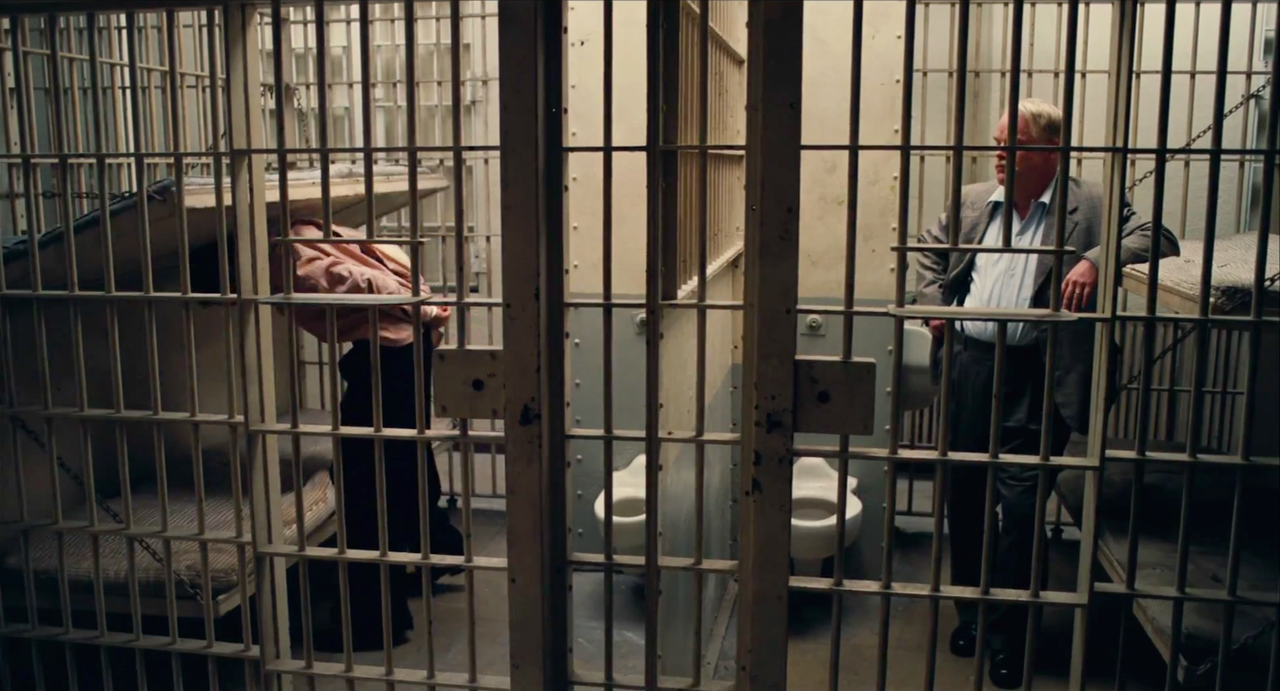
A tough film to include since I think it ultimately falls away, and apart. However, it was engrossing and hypnotic. The 70MM print I watched left me with indelible cinematic memories. Joaquin Phoenix's Freddie Quell may go down as a great movie character. If only Hoffman's Lancaster Dodd was more equally realized.
7. The Queen of Versailles

Though the last third lags a bit, this whirlwind ride down the financial collapse of 2008 is almost a perfect farcical creation. The larger than life characters, trying to keep the lights on and the dog poop off the carpet of their mansion, are so warped that they become a funhouse mirrors into which we cry at our own distorted reflections.
8. 21 Jump Street

All right. This was a very funny movie. It dispensed with the usual re-make/sendup strategy and tried to make us laugh on its own terms. The best part was that almost every single actor in it, even some well-placed cameo players, seemed to get what was happening.
9. Silver Linings Playbook

When was the last time you saw Robert Deniro as vulnerable as he is in this film? A rediscovery of his immense talent is just one of the joys of this romantic comedy by way of recovery melodrama. It is an odd hybrid for sure, but David O. Russell just about manages to pulls off with heart, pain and only a modicum of the schmaltz and pretension that accompanies similar efforts.
10. A Separation

I admit, it is a bit of a cheat on my list, A Separation was released at the very end of 2011 in the U.S., so most of us didn't see it until 2012. However, it is, quite simply, as good as you have heard it to be.
14 August 2012
Spellbound (1945) - Let My Love Open the Door

Doors abound in Alfred Hitchcock's Spellbound.
This 1945 thriller is a combination of the man-on-the run-story, which Hitchcock continually worked on perfecting, and the man-chasing-himself -without-knowing-it story.
Gregory Peck plays a man caught impersonating a noted doctor who has recently disappeared. Once exposed, he claims to have amnesia and demonstrates the symptoms of a man with a deeply repressed trauma. Ingrid Bergman plays the
psychiatrist who tries to help Peck figure out who he really was, and, more
importantly, why he insists on believing he murdered somebody.
Apparently, producer David O Selznick was very taken with
the practice of psychotherapy and took a very personal interest in the project. The opening credits boast an expert
advisor for the psychiatric elements of the plot. A title card informs us that in the process
of psychotherapy, "the analyst seeks only to induce the patient to talk
about his hidden problems, to open the locked doors of his mind."
The film latches onto this like a man with a hammer. The symbol of doors, closed and open, is bluntly wielded at times, but there are few more subtle uses that contribute to some of the film's best moments.
Spellbound is most often remembered for its dream sequences,
which were designed by Salvador Dali. There is a central dream landscape which
contains clues to the murder mystery at the heart of the film. This dream sequence was supposed
to be about 20 minutes worth of footage, but the finished film only features a couple of minutes what was intended.
One dream-like sequence, (I'm not sure if is a Dali concept,) placed early in the film, is composed of a long hallway with doors opening endlessly. This image dissolves into the two leads embracing.

However, just prior to this moment, Hitchcock uses doors to frame
Bergman and Peck as she comes to his room in order to find out more about him. Bergman approaches Peck's door from the stairs. From her point of view we can see the light
spilling at the threshold, telling her that he is still awake.

She at first
avoids the door, but then enters unannounced to find him awake in his bedroom, obviously troubled. She remains standing in the study, and they begin to talk through an open doorway. Hitchcock creates an uneasiness, coupled with an anxiety of
discovery, by using carefully directed eye lines along with framing the scene using
the doorway itself. At an important moment, when
Peck approaches Bergman, nearing the doorway, he even passes through a shadow.

Once he has completely entered the room with Bergman, his
gaze shifts slightly. He is now looking directly at the camera, at us. The result is hypnotic and signals that Bergman's trip down the twisting hallways of
the troubled mind is about to begin.

Unfortunately, though Spellbound has its moments of
suspense, it is bogged down by intrusive explanations of psychotherapy. Peck and Bergman are able to generate some great chemistry as tortured and tentative lovers, and there are a few nice visual elements, but there is not much else going for this minor Hitchcock film.
12 August 2012
Shadow of Doubt - Alfred Hitchcock - Homewrecker

Uncle Charlie always knows where the back stairs are
located. He's bright, outgoing, handsome
and witty; one could never imagine him shying away from a conversation in
public. However, he has a tendency to disappear out a window or a fire escape
just when people are looking for him.
Charlie's niece, and his namesake, begins to favor the back
stairs as well. She wants to avoid her visiting Uncle Charlie who is always
patrolling the parlor or dining room of her family's home, a
two-story house with a nice lawn and quirky neighbors. When she ambles up the front walk, there he is, guarding the front porch in his light-colored suit, smoking his cigar. The wooden steps around the back of the house
become her preferred entrance and egress.
The two Charlies play out this sinister game amidst a sunny,
but drab suburban setting. Just the way Alfred
Hitchcock likes it.
In Saboteur, the film Hitchcock made before Shadow of a Doubt, the entire expanse of America was made claustrophobic. Here, the suspense is telescoped to a pleasant neighborhood in Santa Rosa, and, eventually, the family house itself becomes a prison. The aforementioned back stairs, the
garage and the dining room all transform into possible traps.
This situation is quite different from the original daydreams
of the heroine, Charlotte Newton (Charlie, to her friends and family), when she
conjures a visit from her mother's worldly, bachelor brother, Charlie Oakley.

Charlotte is bored in her safe little community and she has
her well-travelled Uncle on her mind when, almost magically, she receives a
telegram informing her that Uncle Charlie is on his way to stay with them for a while! Her
elation is infectious as she walks down the street, beaming and chanting,
"I knew he'd hear me."
Hitchcock literally dissolves this very innocent and
youthful moment into the oncoming force of a locomotive, the train carrying the
wayward Charles Oakley.
He takes the young Charlie's bedroom for his stay at the
family house, while young Charlie moves in temporarily with her much younger
sister. This displacement of the young
woman grows as she learns more about her Uncle and his strange finances and idiosyncrasies
- he always carries large amounts of cash and he doesn't like his picture being
taken.
Soon, some reporters arrive to do a story on the Newton
family. But are they really reporters? Uncle Charlie seems very wary of them and
when one of them snaps his photo, he insists on them surrendering the
film.
Uncle Charlie transforms from a charming bachelor, to an odd
duck ,to a dark presence as the visit from the "outside" world that
young Charlie so longed for takes up residence with more baggage than she ever
anticipated. Their boring household is
now unsafe as the young Charlie learns a terrible secret about Charles Oakley.
In fact, she literally has to watch her step - did those boards that tripped
her come loose on their own?

Hitchcock seemed to have found a very good collaborator in
screenwriter Thorton Wilder. Wilder's
Pulitzer-Prize-winning play Our Town almost invented the idea of death lurking
behind the ideal image of small town America.
In the young Charlie of Shadow of a Doubt, one can see a bit
of Emily Webb, the heroine of Our Town, who is cautious about marriage. Indeed, when Charlie begins to receive the serious
romantic attention of one of the "reporters" who seem hot on Uncle Charlie's
trail, she is flattered, but halting.
The enormity of societal existence is being laid out to her very
rapidly. Life, marriage, money and death
are all explained in cynical sermons by her Uncle, who intones:
"The cities are full of women, middle-aged widows, husbands, dead, husbands who've spent their lives making fortunes, working and working. And then they die and leave their money to their wives, their silly wives. And what do the wives do, these useless women? You see them in the hotels, the best hotels, every day by the thousands, drinking the money, eating the money, losing the money at bridge, playing all day and all night, smelling of money, proud of their jewelry but of nothing else, horrible, faded, fat, greedy women... Are they human or are they fat, wheezing animals, hmm? And what happens to animals when they get too fat and too old?"
This is quite a strain for the young
Charlie as she finds herself desperately trying to avoid her Uncle, The house
becomes strange to her, and ultimately dangerous. For instance, she shares an intimate moment of romantic
revelation in the house's garage, only to later find the same location is a
deadly snare.

It is not news to anybody that Hitchcock got a great
amount of joy in pushing these macabre ideas to almost perverted ends. His camera seems to take strange pleasure in
robbing Young Charlie of her innocence. He
lingers on her broken spirit as she realizes evil in the world can survive and
thrive, even in the knowledge and view of the righteous. She sees evil, but can do nothing about it.
In a final toast, and a tender moment with
his sister, Uncle Charlie reveals the secret he has learned, that the instinct
to preserve the idea of "home"
and "family", and by extension
community, can provide cover for sinister doings.
Shadow of a Doubt moves Hitchcock a little further into the psychology of domestic life being invaded and taken advantage of by sinister forces. Rebecca and Suspiscion had already probed the infestation of marriage by psychopathic and cynical agents, but Shadow simultaneously expands this vision and turns it inward.
27 June 2012

19 June 2012

10 May 2012
The Cabin In The Woods - Review - Office Space Meets Evil Dead?
 |
| Who's watching? |
More than most films, when reviewing The Cabin in the Woods, the first question one asks is how closely one must hew to the
guidelines set out by the film's creators.
It is probably not news that producer Joss Whedon (Buffy the
Vampire Slayer, The Avengers) and director Drew Goddard (Cloverfield) have implored critics,
podcasters and audience members to try their best not to spoil the many twists
and turns that they have baked into their thriller satire.
Reviewers have approached this request with at least a modicum
of respect, excepting a few
tongue-in-cheek attempts at humor. For
example, the Village
Voice review should only be read by somebody who has seen the film, because it
gives away the ending in the first sentence!
In the end though, Whedon and Goddard's much publicized
entreaty for radio silence is strangely misplaced. For The Cabin in the Woods is not really constructed
as a whiplash inducing plot twister.
Indeed, if you are looking for that floor-dropping-out-from-under-you feeling induced by such mind-benders as The Sixth Sense, The Usual Suspects or The Matrix,
you may be very, very disappointed.
Rather than a brain teaser, or labyrinthine philosophical
puzzle, this masquerading horror film is actually more akin to an open-ended mid-term
question that students are expected to elaborate on at length in blue books
that will never be cracked by the professor.
Let's start at the beginning of the syllabus though. The titular abode in the forest is the
destination of five college friends seeking to blow off steam on a long
weekend, but, right away, you sense that not all of them will be coming
back.
If you think you've seen this movie before, that's the
point!
Like Wes Craven's franchise
engendering, genre-prodding Scream, Whedon and company know you've seen it all
before and they aren't even going to try to pretend you haven't. Almost everything in the opening sequences of
the college romp into the deep woods is by the numbers...only it
isn't.
The young, attractive cast of stereotypical slasher prey
display some strange divergences from the norm in these pictures. Chris Hemsworth's jock archetype, for
instance, has a deep knowledge of economic theory and the stoner character,
played with great aplomb by Franz Kranz, has a pretty
rational and lucid handle on the increasingly weird situation in which the crew
finds themselves.
Also, there is that creepy cabin, the road to which runs by
an abandoned gas station, naturally attended by a sun-wrinkled, grouchy red
neck who warns the students of the dangers ahead. This harbinger of doom seems to be plucked
right from central casting and the cabin seems constructed from the same wood
as the forest cottage in Sam Raimi's ground-breaking film The Evil Dead. This all seems so perfect that we aren't scared as much as we are amused.
Once the kids arrive at
their destination a nice sequence unfolds.
One of the men discovers, behind a rather gruesome painting, a two way
mirror that allows him to see into the adjoining room of one of the sexy
coeds. However, the scene doesn't go as
we are expecting, and indeed it flips our expectations. Who is watching whom? Why would we watch? Do we have the power to look away?
However, we have already been tipped off to these questions
and themes through the introduction of a completely different set of
characters. And here's where that spoiler
question I talked about comes into play.
Trying to honor the filmmakers as best I can, I'll just
briefly explain that within the first few minutes, as we are getting to know
these young lambs heading to the horror movie slaughter, we are also introduced
to two bureaucratic engineer-types operating at some vast-Pentagon-like war
room. Portrayed humorously by Bradley Whitford and Richard Jenkins complete with
ties and white, short-short sleeve shirts these two seem to have wandered in from
Mike Judge's workplace satire Office Space.
 |
| "Somebody has a case of the Mondays!" |
From the start, Cabin in the Woods is about the interplay of
these two worlds and my guess is the filmmakers were relying on our continued
interest in exactly how these worlds connect to buoy their experiment. Unfortunately, too many cats are let out of the bag too
early. We're ahead of the movie a bit
through most of its running time, and, after a while, I got a little impatient waiting for these two worlds to intersect. It does happen, but it is very late in the game.
The collision of these two story lines
unleashes a frenetic orgy of non-stop horror jokiness that is so blood- drenched
that you can't help but giggle with delight at the pure audacity of it. However,
I also couldn't help but think that it was overcompensating for the film's flimsy
and slightly boring middle section.
The Cabin in the Woods is amusing enough and has its moments
that illuminate its themes brilliantly, but without showing a real flair for
horror, or for conspiracy, we are left with bald satire that doesn't really have a
strong enough spine.
Some great filmmakers have tried to twist genres inside out
with more successful results artistically. Stanley
Kubrick's The Shining and his thriller take Eyes Wide Shut are an example. And Michael Haneke subverted the expectations
of the horror genre with his movie Funny Games.
It doesn't appear that Whedon and Goddard are attempting
the same sort of experiments that Kubrick and Haneke did, and their movie is a lot of fun despite that, but I found myself
wishing they had tried a little harder.
I will give them this though, they really go for broke with
the ending of this movie, and, while not a real twist, it is delightfully
subversive.
And unlike that Village Voice reviewer, I'll keep it confidential!
19 April 2012

07 April 2012
Moneyball - Visual Strategy - Ghosts of the Past
Moneyball is an interesting film. It is not entirely successful, but at the very least, (unlike many Hollywood films these days,) it takes its shots and design seriously.
Here are just some of the shots which emphasize the weight of the game's past on the shoulders of Billy Beane, played by Brad Pitt.
In these cases, the old photos of baseball's great teams and players loom heavily in front of him, behind him, and over his shoulder.


Here are just some of the shots which emphasize the weight of the game's past on the shoulders of Billy Beane, played by Brad Pitt.
In these cases, the old photos of baseball's great teams and players loom heavily in front of him, behind him, and over his shoulder.


28 March 2012

03 March 2012
Orca (1977) - Great Locations, a Good Score and an Odd Ending Saved This Sinking Picture

In 1977, movie mogul Dino DeLaurentis hopped on the killer
shark train and fast-tracked a high seas leviathan horror picture that now occupies a
strange position in the B-cinema archives.
The resulting movie, Orca, a tale of a vengeful killer whale
in mortal combat with a grizzled fisherman, sank at the box office and was
harpooned by the critics, but it strangely never entered the realm of Ed
Wood-dom, the kind of movie that is so bad it's good.
Instead - if reading comments on YouTube clips of the film or
on various message boards is any indication - the film has attained cult status
as a kind of eco-horror show.
Watching it today, it is difficult to understand the vitriol
it faced from its harshest critics.
After the visceral thrill ride of Steven Spielberg's Jaws just two years
earlier, many must have thought the lugubrious pace of Orca to be interminable and inexcusable for a
killer fish picture.

After a local scientist, (Charlotte Rampling) doing research off the coast of
Nolan's fishing village, lectures Harris on the uniqueness of these creatures and their limitless intellectual capacity, Nolan decides to try and catch
one. This leads to an all out battle
between man and giant predator that strains credulity to the breaking point and then pushes further.
It would seem that this movie would be ripe for midnight
screenings, especially since it includes a scene in which the titular orca
demonstrates knowledge of how to dismantle a natural gas line and then even knocks over a lantern to ignite the fumes.
Why then, is Orca not so bad it is good? There are a couple things working to save it.
First, and foremost, is the haunting score by
legendary film composer Ennio Morricone. Yes, that Ennio Morricone.
Right from the opening frames, where the titles alternate with some type of sonar tracking device, Morricone's simple notes are almost a counterpoint to John Williams' famous opening bars of the Jaws soundtrack.
Right from the opening frames, where the titles alternate with some type of sonar tracking device, Morricone's simple notes are almost a counterpoint to John Williams' famous opening bars of the Jaws soundtrack.
Second is the beautiful location in which the film takes place. Filmed in Newfoundland, the vistas and colors
of the fishing village are stunning.

For years, Orca was only available on a pan and scan VHS transfer, but now it can be seen on DVD with its original widescreen presentation.

And there are some really good shots as well - shots that would probably be iconic in a better movie.


For years, Orca was only available on a pan and scan VHS transfer, but now it can be seen on DVD with its original widescreen presentation.

And there are some really good shots as well - shots that would probably be iconic in a better movie.

Lastly, the screenplay, despite hampering the film on a scene by scene basis, charts a story with an epic sweep that Morricone's score helps to buoy through to the
end. Rather than throwing together a
shark-eats-swimmers gore fest, the writers of Orca, (who also penned many Sergio
Leone films,) tried to fashion a revenge tale that cobbles together elements of
Moby Dick and Greek tragedy.
When the film is this realm, it is actually not bad, and Richard Harris is very good as a man who is deeply troubled by his action, (the movie contains a stunningly horrific scene in which Captain Nolan, in his zeal to capture a killer whale maims and kills a female whale and its baby,) and therefore obsessed with this creature that is more and more unpredictable.
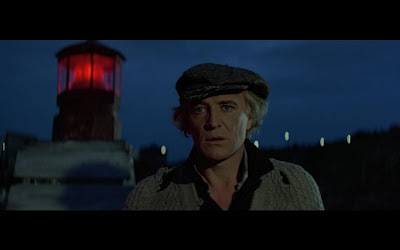
When the film is this realm, it is actually not bad, and Richard Harris is very good as a man who is deeply troubled by his action, (the movie contains a stunningly horrific scene in which Captain Nolan, in his zeal to capture a killer whale maims and kills a female whale and its baby,) and therefore obsessed with this creature that is more and more unpredictable.

In the heart of the film, there is a great scene where Harris goes down to a jetty
because somebody has told him that a fin was spotted there. He goes at dusk and looks out at the water, but he sees nothing - only the gentle water. He smirks and then turns away to leave. There is the
smallest splashing sound, and he turns around again. He waits, looking out over the dark water for a long moment. He is just about to turn
again, when he hears more gentle splashing and sees the water roiling just a bit. Then, as he strains to see in the gathering darkness, there is the
movement of white and black under the surface of the water. When the film is focused like this, it is compelling.
However, when the film is trying to shoehorn in spectacular
explosions and orca attacks on Harris's crew, the results are eye-rolling. (I won't go into the horrible expository dialogue.)
The finale of Orca certainly turns the tables on the
ending of any of the Jaws films. I remember being surprised and troubled by it when I saw the movie as a kid. But the sequence seems rushed, and the execution of it is edited badly and shot clumsily.
The idea of the climax taking place in the icy north Atlantic is a good one, but the actual scenes were shot in Malta, using iceberg mock-ups, so the power of it is diminished and the visuals are almost laughable. More unfortunate is the fact that this is the worst part of the picture transfer on the currently available DVD and streaming options.

The way the ending is handled is symbolic of the way the rest of the film is handled. Somewhat mythic and poetic ideas, choked off by attempts to also deliver a monster movie.
The movie is currently available on Netflix streaming.
The idea of the climax taking place in the icy north Atlantic is a good one, but the actual scenes were shot in Malta, using iceberg mock-ups, so the power of it is diminished and the visuals are almost laughable. More unfortunate is the fact that this is the worst part of the picture transfer on the currently available DVD and streaming options.

The way the ending is handled is symbolic of the way the rest of the film is handled. Somewhat mythic and poetic ideas, choked off by attempts to also deliver a monster movie.
The movie is currently available on Netflix streaming.
Subscribe to:
Posts (Atom)