
19 June 2012


10 May 2012
The Cabin In The Woods - Review - Office Space Meets Evil Dead?
 |
| Who's watching? |
More than most films, when reviewing The Cabin in the Woods, the first question one asks is how closely one must hew to the
guidelines set out by the film's creators.
It is probably not news that producer Joss Whedon (Buffy the
Vampire Slayer, The Avengers) and director Drew Goddard (Cloverfield) have implored critics,
podcasters and audience members to try their best not to spoil the many twists
and turns that they have baked into their thriller satire.
Reviewers have approached this request with at least a modicum
of respect, excepting a few
tongue-in-cheek attempts at humor. For
example, the Village
Voice review should only be read by somebody who has seen the film, because it
gives away the ending in the first sentence!
In the end though, Whedon and Goddard's much publicized
entreaty for radio silence is strangely misplaced. For The Cabin in the Woods is not really constructed
as a whiplash inducing plot twister.
Indeed, if you are looking for that floor-dropping-out-from-under-you feeling induced by such mind-benders as The Sixth Sense, The Usual Suspects or The Matrix,
you may be very, very disappointed.
Rather than a brain teaser, or labyrinthine philosophical
puzzle, this masquerading horror film is actually more akin to an open-ended mid-term
question that students are expected to elaborate on at length in blue books
that will never be cracked by the professor.
Let's start at the beginning of the syllabus though. The titular abode in the forest is the
destination of five college friends seeking to blow off steam on a long
weekend, but, right away, you sense that not all of them will be coming
back.
If you think you've seen this movie before, that's the
point!
Like Wes Craven's franchise
engendering, genre-prodding Scream, Whedon and company know you've seen it all
before and they aren't even going to try to pretend you haven't. Almost everything in the opening sequences of
the college romp into the deep woods is by the numbers...only it
isn't.
The young, attractive cast of stereotypical slasher prey
display some strange divergences from the norm in these pictures. Chris Hemsworth's jock archetype, for
instance, has a deep knowledge of economic theory and the stoner character,
played with great aplomb by Franz Kranz, has a pretty
rational and lucid handle on the increasingly weird situation in which the crew
finds themselves.
Also, there is that creepy cabin, the road to which runs by
an abandoned gas station, naturally attended by a sun-wrinkled, grouchy red
neck who warns the students of the dangers ahead. This harbinger of doom seems to be plucked
right from central casting and the cabin seems constructed from the same wood
as the forest cottage in Sam Raimi's ground-breaking film The Evil Dead. This all seems so perfect that we aren't scared as much as we are amused.
Once the kids arrive at
their destination a nice sequence unfolds.
One of the men discovers, behind a rather gruesome painting, a two way
mirror that allows him to see into the adjoining room of one of the sexy
coeds. However, the scene doesn't go as
we are expecting, and indeed it flips our expectations. Who is watching whom? Why would we watch? Do we have the power to look away?
However, we have already been tipped off to these questions
and themes through the introduction of a completely different set of
characters. And here's where that spoiler
question I talked about comes into play.
Trying to honor the filmmakers as best I can, I'll just
briefly explain that within the first few minutes, as we are getting to know
these young lambs heading to the horror movie slaughter, we are also introduced
to two bureaucratic engineer-types operating at some vast-Pentagon-like war
room. Portrayed humorously by Bradley Whitford and Richard Jenkins complete with
ties and white, short-short sleeve shirts these two seem to have wandered in from
Mike Judge's workplace satire Office Space.
 |
| "Somebody has a case of the Mondays!" |
From the start, Cabin in the Woods is about the interplay of
these two worlds and my guess is the filmmakers were relying on our continued
interest in exactly how these worlds connect to buoy their experiment. Unfortunately, too many cats are let out of the bag too
early. We're ahead of the movie a bit
through most of its running time, and, after a while, I got a little impatient waiting for these two worlds to intersect. It does happen, but it is very late in the game.
The collision of these two story lines
unleashes a frenetic orgy of non-stop horror jokiness that is so blood- drenched
that you can't help but giggle with delight at the pure audacity of it. However,
I also couldn't help but think that it was overcompensating for the film's flimsy
and slightly boring middle section.
The Cabin in the Woods is amusing enough and has its moments
that illuminate its themes brilliantly, but without showing a real flair for
horror, or for conspiracy, we are left with bald satire that doesn't really have a
strong enough spine.
Some great filmmakers have tried to twist genres inside out
with more successful results artistically. Stanley
Kubrick's The Shining and his thriller take Eyes Wide Shut are an example. And Michael Haneke subverted the expectations
of the horror genre with his movie Funny Games.
It doesn't appear that Whedon and Goddard are attempting
the same sort of experiments that Kubrick and Haneke did, and their movie is a lot of fun despite that, but I found myself
wishing they had tried a little harder.
I will give them this though, they really go for broke with
the ending of this movie, and, while not a real twist, it is delightfully
subversive.
And unlike that Village Voice reviewer, I'll keep it confidential!
19 April 2012

07 April 2012
Moneyball - Visual Strategy - Ghosts of the Past
Moneyball is an interesting film. It is not entirely successful, but at the very least, (unlike many Hollywood films these days,) it takes its shots and design seriously.
Here are just some of the shots which emphasize the weight of the game's past on the shoulders of Billy Beane, played by Brad Pitt.
In these cases, the old photos of baseball's great teams and players loom heavily in front of him, behind him, and over his shoulder.


Here are just some of the shots which emphasize the weight of the game's past on the shoulders of Billy Beane, played by Brad Pitt.
In these cases, the old photos of baseball's great teams and players loom heavily in front of him, behind him, and over his shoulder.


28 March 2012

03 March 2012
Orca (1977) - Great Locations, a Good Score and an Odd Ending Saved This Sinking Picture

In 1977, movie mogul Dino DeLaurentis hopped on the killer
shark train and fast-tracked a high seas leviathan horror picture that now occupies a
strange position in the B-cinema archives.
The resulting movie, Orca, a tale of a vengeful killer whale
in mortal combat with a grizzled fisherman, sank at the box office and was
harpooned by the critics, but it strangely never entered the realm of Ed
Wood-dom, the kind of movie that is so bad it's good.
Instead - if reading comments on YouTube clips of the film or
on various message boards is any indication - the film has attained cult status
as a kind of eco-horror show.
Watching it today, it is difficult to understand the vitriol
it faced from its harshest critics.
After the visceral thrill ride of Steven Spielberg's Jaws just two years
earlier, many must have thought the lugubrious pace of Orca to be interminable and inexcusable for a
killer fish picture.

After a local scientist, (Charlotte Rampling) doing research off the coast of
Nolan's fishing village, lectures Harris on the uniqueness of these creatures and their limitless intellectual capacity, Nolan decides to try and catch
one. This leads to an all out battle
between man and giant predator that strains credulity to the breaking point and then pushes further.
It would seem that this movie would be ripe for midnight
screenings, especially since it includes a scene in which the titular orca
demonstrates knowledge of how to dismantle a natural gas line and then even knocks over a lantern to ignite the fumes.
Why then, is Orca not so bad it is good? There are a couple things working to save it.
First, and foremost, is the haunting score by
legendary film composer Ennio Morricone. Yes, that Ennio Morricone.
Right from the opening frames, where the titles alternate with some type of sonar tracking device, Morricone's simple notes are almost a counterpoint to John Williams' famous opening bars of the Jaws soundtrack.
Right from the opening frames, where the titles alternate with some type of sonar tracking device, Morricone's simple notes are almost a counterpoint to John Williams' famous opening bars of the Jaws soundtrack.
Second is the beautiful location in which the film takes place. Filmed in Newfoundland, the vistas and colors
of the fishing village are stunning.

For years, Orca was only available on a pan and scan VHS transfer, but now it can be seen on DVD with its original widescreen presentation.

And there are some really good shots as well - shots that would probably be iconic in a better movie.


For years, Orca was only available on a pan and scan VHS transfer, but now it can be seen on DVD with its original widescreen presentation.

And there are some really good shots as well - shots that would probably be iconic in a better movie.

Lastly, the screenplay, despite hampering the film on a scene by scene basis, charts a story with an epic sweep that Morricone's score helps to buoy through to the
end. Rather than throwing together a
shark-eats-swimmers gore fest, the writers of Orca, (who also penned many Sergio
Leone films,) tried to fashion a revenge tale that cobbles together elements of
Moby Dick and Greek tragedy.
When the film is this realm, it is actually not bad, and Richard Harris is very good as a man who is deeply troubled by his action, (the movie contains a stunningly horrific scene in which Captain Nolan, in his zeal to capture a killer whale maims and kills a female whale and its baby,) and therefore obsessed with this creature that is more and more unpredictable.
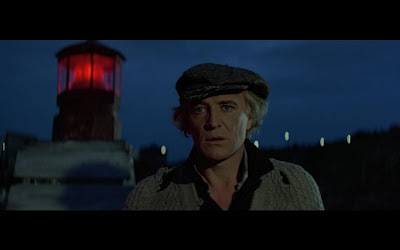
When the film is this realm, it is actually not bad, and Richard Harris is very good as a man who is deeply troubled by his action, (the movie contains a stunningly horrific scene in which Captain Nolan, in his zeal to capture a killer whale maims and kills a female whale and its baby,) and therefore obsessed with this creature that is more and more unpredictable.

In the heart of the film, there is a great scene where Harris goes down to a jetty
because somebody has told him that a fin was spotted there. He goes at dusk and looks out at the water, but he sees nothing - only the gentle water. He smirks and then turns away to leave. There is the
smallest splashing sound, and he turns around again. He waits, looking out over the dark water for a long moment. He is just about to turn
again, when he hears more gentle splashing and sees the water roiling just a bit. Then, as he strains to see in the gathering darkness, there is the
movement of white and black under the surface of the water. When the film is focused like this, it is compelling.
However, when the film is trying to shoehorn in spectacular
explosions and orca attacks on Harris's crew, the results are eye-rolling. (I won't go into the horrible expository dialogue.)
The finale of Orca certainly turns the tables on the
ending of any of the Jaws films. I remember being surprised and troubled by it when I saw the movie as a kid. But the sequence seems rushed, and the execution of it is edited badly and shot clumsily.
The idea of the climax taking place in the icy north Atlantic is a good one, but the actual scenes were shot in Malta, using iceberg mock-ups, so the power of it is diminished and the visuals are almost laughable. More unfortunate is the fact that this is the worst part of the picture transfer on the currently available DVD and streaming options.

The way the ending is handled is symbolic of the way the rest of the film is handled. Somewhat mythic and poetic ideas, choked off by attempts to also deliver a monster movie.
The movie is currently available on Netflix streaming.
The idea of the climax taking place in the icy north Atlantic is a good one, but the actual scenes were shot in Malta, using iceberg mock-ups, so the power of it is diminished and the visuals are almost laughable. More unfortunate is the fact that this is the worst part of the picture transfer on the currently available DVD and streaming options.

The way the ending is handled is symbolic of the way the rest of the film is handled. Somewhat mythic and poetic ideas, choked off by attempts to also deliver a monster movie.
The movie is currently available on Netflix streaming.
20 February 2012

Subscribe to:
Posts (Atom)