29 August 2015

The Search for General Tso - Food reveals our history - Good and bad


Near the end of the documentary The Search for General Tso, two avatars of the film's primary interests - Chinese history and Chinese cuisine - celebrate, but also lament, the proliferation of Chinese culture throughout the West, particularly America .

A fifth generation descendant of General Tso himself is flattered and hopeful that the General's name is so well known throughout the United States, but sad that it has no real connection to the incredible historical feats of the actual General, a hero of Hunan province in China.

Meanwhile, an influential chef, who once fled from Hunan to Taiwan, is impressed with how much Chinese cuisine, (inspired by the wonderful culinary traditions of his homeland,) is consumed in America, but regrets about how Westernized those foods have become in the process. 

In a simple quest to find the origin of the ubiquitous dish of the documentary's title, the filmmakers end up telling the story of American and Chinese relations including geopolitics and immigration. They travel across the world in their inquiry, speaking to foodies, restauranteurs, chefs and historians. 

The story of the multi-billion dollar Chinese food industry in the United States is, as one of the talking heads in the film puts it, "the story of the Chinese in America."  It was birthed out of draconian policies put in place to suppress the Chinese population who had come to this country in droves to gain employment during the railroad boom.


Chinese, who legally could not gain any type of employment, started laundry services and restaurants as a way to survive. And to assimilate. 

There are Chinese restaurants in some very remote places in the country and the filmmakers go to them to hear their stories.  And all of them include details of how they adjust their menus to the tastes of their regional American customers.  A very common response from the Chinese who own these restaraunts: "The Chinese food Americans like is very bland."

The story takes a lot of twists and turns through history and opens up some questions that stuck with me..  For instance, one commentator notes that fine Chinese food takes just as much labor and craft as French food, but Americans will not pay premium price for Chinese food. 

Also, there is a section of the film exploring a massive network of social organizations that help staff and support Chinese food establishments across the country. 

The pace of the film is  leisurely and methodical and it doesn't have any real surprises or urgency that will keep you hanging on the edge of your seat.  In fact, it feels like the final answer to the film's central question was known way before they even started rolling cameras. 

But it is always interesting and supported by fun graphical interludes.  And as much as it is the inspiring story of people coming from nothing and building successful businesses and a whole industry, it's also a shameful look at our how our country's xenophobic policies made it very hard on them. 


26 August 2015

Stay away from reviews of The Gift! Especially the New York Times one


Having just posted my own review of the thriller The Gift, my advice seems self-defeating.  But I mean it.

The Gift is a thriller that unfolds organically and takes some nice twists and turns. It subverts some genre conventions and toys with others.  It is best experienced with as little information as possible upfront.

I had seen the trailer for the film back before the movie was released and took note of it simply because Jason Bateman seemed to be playing a more dramatic role, and because it included Rebecca Hall, who makes every movie better.  However, at least from the trailer, it appeared that this was a predictable stalker genre film about somebody tormenting a couple in their new home -  Pacific Heights, anybody?

As the film gained some positive buzz on Twitter and racked up an impressive score on Rotten Tomatoes, I was very intrigued. And, after seeing it this past weekend, I began to check out some reviews.

Wow. The first one I read - the New York Times review by Stephen Holden - gave away way too much. Several others did as well.

Now, I'm sympathetic to reviewers trying to hit a word count, and I'll admit that Mr. Holden doesn't give away any major spoilers, but I would have had considerably different experience if I had read that review before seeing the film.

I did find many writers doing a pretty good job at critically discussing the film and performances, and taking care to weave around things just enough to not give away the game.

Intrigued, I tried my hand at writing a little review of the film myself, and it wasn't easy.  I ended up concentrating on the style and some of the visual motifs, but my review seemed anemic and vague.

I'm not a spoiler cop at all.  I think the idea of spoiler warnings has gone a little too far in recent years. But this is one case where I find myself putting on the uniform and sounding the alarm.

The Gift is a good movie and deserving of its current 92% on Rotten Tomatoes.  I don't usually do this, but I'd advise you to just trust that aggregate score, skip reading the reviews, and check out the film while it is still and theaters. Hurry before it gets spoiled for you.

25 August 2015

Review -The Gift (2015) - Through the Glass, The Past Will Find You


There is a lot of glass in The Gift, Joel Edgerton's debut as a director and writer.  Windows, wine goblets and mirrors reflect, refract and act as invisible barriers. The opening shots are of an empty modern home, sunlight streaming through its floor-to-ceiling windows.

Simon (Jason Bateman) and his wife Robyn (Rebecca Hall) are checking it out as possible new home as Simon has landed a big new job with an area start-up.  The house is bright and has a spectacular view, but as they close the deal and begin to set up their happy home, you start to notice how little privacy all that transparency provides.

And it is through another glass that we first view Gordon, an unassuming looking man with a goatee and dressed casually. He is in the corner of the frame, observing Simon in a store, picking some things out for the new house. After an introduction Simon vaguely remembers Gordon as "Gordo."

It seems they went to high school together.  While the exchange is not awkward or weird, it is just slightly unsettling.  Simon seems to just barely remember Gordo, but Gordo seems tentative, as if Simon should remember him very well.


Before we know it, Gordo is appearing quite a bit at the house,  politely bearing gifts and helping them get their new home up and running. He appears in windows, looking in, as if he is searching for something. Robyn, feeling the stress of transitioning from running a design firm to trying to start a family, sort of welcomes Gordo in the midst of all of this, or at least feels bad for him in some way.

However, Simon is getting less patient and starts to view Gordo as mentally unstable. He thinks his high school acquaintance may be imagining that they were better friends than they were, or worse, Gordo could be developing an unhealthy obsession with Robyn.

And after reading all of this, you may think you know where this is going.  You don't, or at least I didn't. The story, written by Edgerton, makes all the right feints to make you think you are a step ahead, but then it jukes you.  Smartly keeping the focus on psychological mind games, Edgerton keenly shapes his themes of memory, the past, privacy and secrets.


At one point, Gordo asks Simon, who works for an Internet security company, what he thinks of the NSA spying scandal. We are always being watched and analyzed, yet we can sometimes keep secrets of the past, even from our most intimate partners. By the end of the film, the glass walls of the house will provide no safety for the couple.

The Gift is one of those movies that is hard to discuss without spoiling it too much. If you are up for a thriller, and willing to take the ride, you'll be rewarded by the turns of the plot, but also the nice visual motifs that Edgerton layers within the film.  


24 August 2015

James Bond - Dr. No - Minimalist Template for Grandness and Goddesses


Late in Dr. No, the 1962 spy thriller that introduced moviegoing audiences agent 007, James Bond (Sean Connery) is sneaking through a network of large ventilation shafts, some of which release torrents of water and some of which are extremely hot.  He comes to intersections and he has to make a quick decision to go left or right, up or down.

The scene is almost avant-garde by today’s action standards.  It is wordless, the only sounds are far off rattles and clangs echoing in the shafts.  Bond makes his way through the tunnels and actually into the heart of the command center of Dr. No, who is the villain of this first entry into the film franchise.  The climax of the film starts to ramp up, when, finally, we hear something that has been absent for a long time: the score.

Indeed, this long stretch of the film has proceeded without any music backing it.  Today, we are used to heavy, and sometimes quite good, compositions for action films.  So, it is a little conspicuous to go without it for so long in an action thriller.  However, the editing and the direction come together in a way that definitely builds tension towards the final confrontation.

19 January 2015

Coverage - What I've Been Watching

Snowpiercer


I missed the party, or, I guess, the train on this one. Currently hovering at over 90% on Rotten Tomatoes and on many critics Top Ten lists for 2014, this dystopian sci-fi action thriller slows down the further up the train its rebel dregs of society get. The filmmaker doesn't seem to know what do as the rag-tag group advances, so the movie starts stretching out action sequences and recycling well-worn tropes of the many genres it is pulling into its orbit. All the actors, especially Tilda Swinton seem game for the ride, but the film never gets back on track after she departs.

Coherence


In the spirit of Primer and the under-seen mind-bender Triangle, this low budget ensemble piece starts as a mumblecore-type dinner party movie, like we've seen a hundred times in the past eight years. However, a passing comet starts to affect the guests in strange ways. Very interesting through most of its running time, it also sticks the landing better than many other films of its type.

In Fear


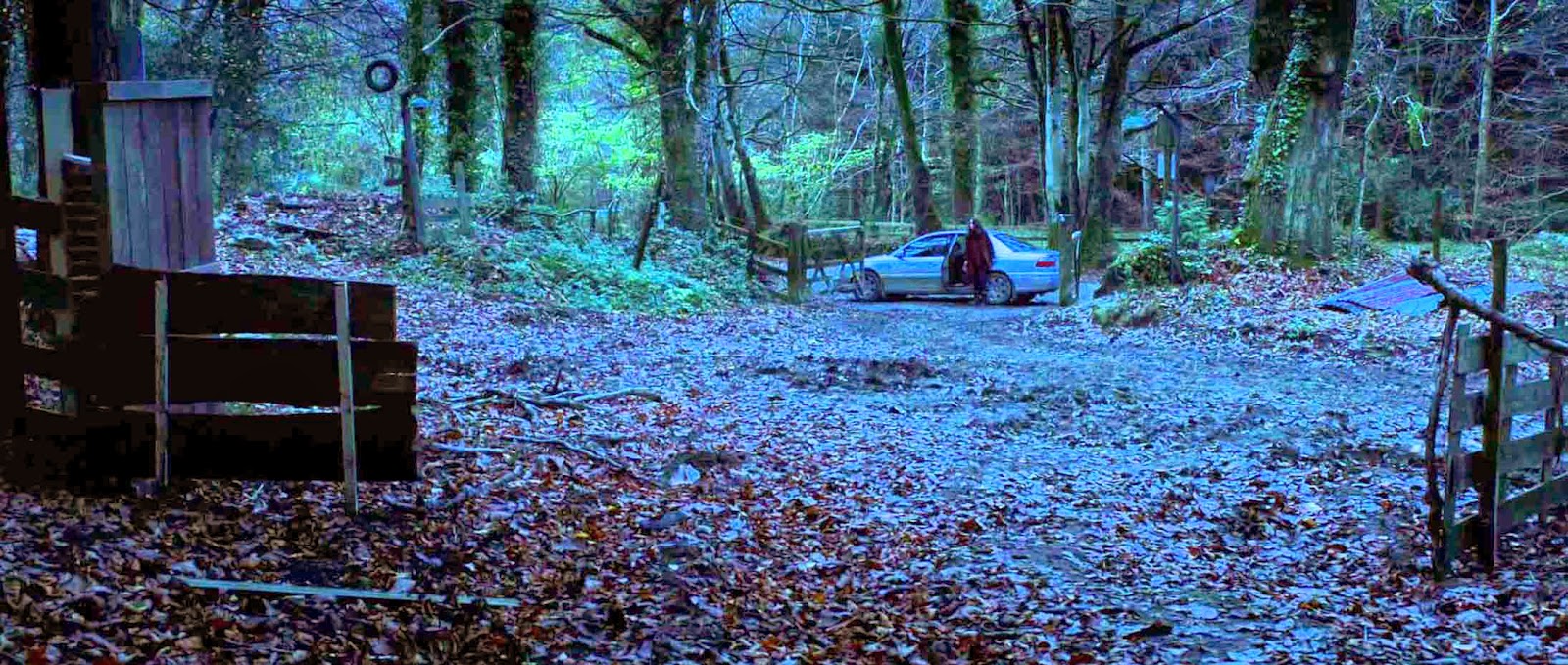
The desolate English countryside and the narrow, tree-lined woods, through which this couple have to navigate as night falls and strange events begin to happen, is the best character. The atmosphere is creepy and the maze of trails get more tight and claustrophobic, but the film falters as it runs into its second half, only temporarily picking up a little jolt from the performance of an added character with a twisted smile and a glint in his eye.  Once the usual climactic beats kick in, the film gets less and less interesting.

The Babadook


The Babadook promises a lot with its slow buildup and its gambit of saddling the protaganist, a widowed single mother, with a kid prone to flights of maddening screaming or fits. Essie Davis, in a bravura performance that leaves everything on the table, screams at the child, "why can't you just be normal!" We feel for her, deeply. While the introduction of a sinister, Edward Gorey type pop-up book fills the dark corners of our mind with horrifying possibilities, the film abandons this innovation to give us warmed over homages to moments from other horror classics, almost like ticking off boxes: The Exorcist, The Shining, Nightmare on Elm Street, The Grudge, etc. It becomes apparent that the filmmaker is less interested in making a truly terrifying film, and more insistent on making sure that we get the deeper meaning, that we know that we're not just getting a horror flick, but a story with themes. As a harrowing story of the closed world of a damaged mother and son, the movie is solid. There are genuine creepy moments and some interesting sequences, but don't come for The Babadook, instead this is Essie Davis's film from the first frame. Her performance leaves nothing behind and she commits to every single moment.

The Unknown Known


Errol Morris is a national treasure, and this interview, his second with a U.S. Secretary of Defense who presided over a complicated quagmire of war, is a fascinating chase down a rabbit hole of beauracratic thinking gone wild. Morris and Rumsfeld are actually quite well matched, and Rumsfeld comes off as an amazing performance artist, who has perfected his bit so well that he long ago bought completely into it. I'm not sure you could create a better fictional character to represent the military industrial complex of the Iraq War era. Danny Elfman's score is odd and distracting at points.


09 June 2014

Movie Shot of the Week - M.A.S.H. (1970)

24 May 2014

Godzilla (2014) - Review


Very late in the newest entry in the Godzilla franchise, the giant titular lizard has leveled half of San Francisco, but finds himself only halfway to his goal of defeating his enemies.   His massive frame, supported by two impossibly large legs, slumps, and his shoulders droop into a fatigued sigh. It's as if he’s moaning, “ whew, how much more of this?"


"I know how you feel, big guy," I wanted to shout at the screen.  

This monster action movie takes a long time to get the monsters and then lays on a lot of action  late in the game. 

The good news is that moviegoers who have an intense interest in seeing the old fashioned Godzilla fully realized through the best of modern cinematic technology will come away satisfied. The bad news is that anybody looking for almost anything else will most likely walk away shrugging. 

The original Godzilla film, made in 1954, was birthed in direct response to incidents involving nuclear weaponry and its effects on the Japanese people.   In director Gareth Edwards new re-imagining, the premise, involving Japanese nuclear reactors, admittedly brings up the shadow of the recent Fukishima disaster, but is tossed into the narrative with less care than a ripped-from-the-headlines Law and Order episode.    

Bryan Cranston, fresh off his artistic triumph as Walter White in AMC's series Breaking Bad plays a nuclear scientist living in Japan and running a power plant with his wife played by Juliette Binoche.  Steadily ncreasing tremors trigger a full meltdown and disaster at the plant, but when we flash 15 years forward, it seems that the disaster may have been something else entirely. Cranston's scientist, now a loner and estranged from his only son, is sure that the government, which still keeps a strict quarantine on the area is lying to the public about what really happened.  

Guess what? They are! And, like all government operations in these disaster monster movies, there are tens of thousands of personnel involved in these top secret machinations. As these things usually go, the experiments conducted get out of control fast, and soon there is a prehistoric creature on the loose, and it feeds on nuclear material!  This flat-headed, winged creature seems to be a nod to another famous Japanese monster creation Rodan, and it turns out that it isn't alone!   

You might notice that in my summation of the plot so far I haven't even mentioned Godzilla. Exactly!  Most of the movie's first half is establishing Godzilla's antagonists, which the U.S. military, in its inimitable fashion, names the M.U.T.O.'s (Massive Unidentified Terrestrial Organisms.) In truth, the military doesn't seem very perturbed. In fact, everybody is pretty calm about this impending titanic clash between a couple of mating MUTOS and now-wakened Godzilla, who seems, for some reason,  incredibly intent on locking horns with these creatures.

Apparently, Godzilla has risen from the depths in response to the presence of the MUTO's , seeing them as worthy prey for his apex predator tastes.  This is all according to a pair of scientists; both are played by the way overqualified duo of Ken Wantanabe and  Sally Hawkins. They explain everything with about as much excitement as the military does. Everything is so matter-of-fact in this film that it is hard for any suspense to materialize. 

In trying to follow the classic formula of indirectly revealing the monster over time, a technique popularized by Steven Spielberg's Jaws, the film is infused with aimlessness that even the spectacular destruction of two major U.S. cities can't redeem. I will admit that the filmmaker does get off a shot of genuine irony when Godzilla finally appears full bodied on screen.
   
Ken Wantanbe's scientist and David Straithern's Admiral
wait around some more.
But, mostly, we wait.  This is a film in which main characters spend a good amount of time on a Navy ship, following Godzilla's huge spiked back as it cuts a wake at a comfortable speed through the Pacific.  One exception is a suspenseful nighttime mission where two soldiers are trying to evade a lurking MUTO while they maneuver on a high railroad trestle. 

Back to the good news, though. Godzilla looks great and moves, well, like a guy in big rubber suit, and I mean that in the best way possible. When the gigantic, and I mean gigantic, reptile is pushing the MUTOs around the city, he seems like a live wrestling bear rather than some sleek CGI creation . He really is a great technical achievement.  It is pretty thrilling to see the infamous Godzilla roar send ripples through his neck muscles. The MUTOs, on the other hand,  look more like the standard issue creatures that seem to inhabit summer blockbusters over the last five or six years, although I do like the way they crack open nuclear missiles and chug the radiation inside like they were a  downing a Red Bull.

All of this technical magic comes later in the movie, (which isn't really that unusual for a monster film,) but what is unusual is the way the human stories are treated so perfunctorily.  Director Gareth Edwards made a small stir with his indie film Monsters back in 2010.  In that film, the creatures also take their time revealing themselves, but there was much more suspense built through the growing connection between the two human protagonists, so that when all hell cuts loose, we're on the edge of our seat.


While Godzilla cuts a fine 3D figure in this updated version, he couldn't care less about the humans underfoot. Now,  that can be excused for a 300 foot prehistoric apex predator, but I’m not sure filmmakers should get the same pass.