26 October 2010

Paranormal Activity - More of the Same - But That's O.K.


Paranormal Activity 2 is a rare kind of sequel. It is exactly as good as its predecessor. However, this means that while it is no worse, it is also no better.

Well, let me revise that. There is a little tedium that sets in with the second installment because the concept doesn't feel as fresh. They have a found a way to multiply the passive camera effect, but, unfortunately, more angles only produce more of the same after a while.


Some things I found interesting about the writing: (Slight spoilers.)

1. The franchise still hasn't established any sort of clear story rules. We know that this is a demon, but what are its powers? Its operating procedures are very hazy - sometimes it leaves footprints, but other times it seems to float as a vapor?

2. The "prequel" structure of the second movie sets up a third act that may be very difficult for audience members to completely follow if they haven't seen the first movie. Although this could be deliberate - making a kind of interlocking series of stories that rotate around each other.

3. Like the first movie, the characters in the second movie do things that just simply don't make sense. For instance, in this movie, it is weird when one character at a certain point doesn't simply go to a neighbor's house. (Those who have seen the movie will understand.)

Paranormal Activity 2 provides several really good jumps, some minor scares and some very suspenseful moments, but beyond that it is not much. However, if you are looking for that, you pretty much can't go wrong, which may be its appeal.

Many critics are straining to make something out of the upper middle class "mcmansion" setting of both films, but after the second one, I am almost convinced the filmmakers have no real interest in that idea.

27 September 2010

Get a Prorated Ticket for the First Five Minutes of Devil...

The opening title sequence of Devil, a new horror film "from the mind of M. Night Shyamalan" is fantastic.

The camera soars over the suspension bridges and skyscrapers of Philadelphia, but the simple act flipping the picture upside down works beautifully to achieve just the right mixture of unease, tension and, well, fun that the movie needs.

However, the rest of the film, I'm sorry to report, just keeps going downhill from there. This movie was not screened for critics, but it is not nearly bad enough to warrant that particular move by the studio - that's usually reserved for real turkeys.


Below, the trailer gives you a taste of those opening visuals, but seeing it on a big movie screen is more impressive, or at least it was for me. Save your money though.


26 August 2010

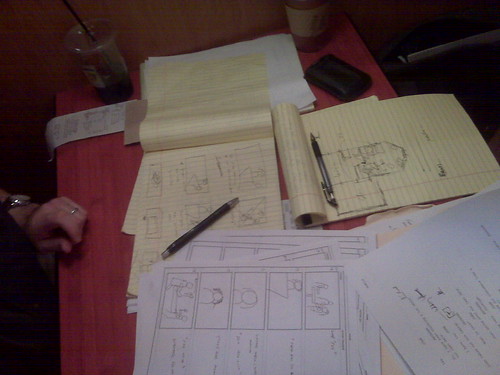
What do filmmakers do at lunch anyway?

The director and I work out an upcoming shoot for our short film.

19 August 2010

Jaws on the Big Screen


Just got back from seeing Jaws on the big screen at the Somerville Theatre. It is playing tomorrow night as well.

As you can see from the promotion above, there was plenty of good fun had by all. And I can report that Jaws still can make 'em jump!

14 August 2010

Columns and Temples In Kubrick's Full Metal Jacket


Stanley Kubrick's Full Metal Jacket is often critiqued as being two different movies. The first half is a spartan portrayal of Marine boot camp that ends with a bloody look into to the face of madness. The second half brings several of the players from that fascinating basic training sequence into actual fighting in the cities of Vietnam. The second half climaxes in an assault on a building in which a sniper is pinning down and picking off Marines.

However, there is so much symmetry connecting the first half and the second that it is really hard to separate them.

I thought I would just show one of the image motifs Kubrick enforces in the first half of the film, only to spring it on us in the climax of the second.

There is, of course, the above image which, with the recruits in their white underwear and t-shirts, emphasizes the orderliness of basic training. The exception to the rigor of the shot above is the jelly donut being eaten by Private Pyle, along with the scattered contents of his footlocker - it almost makes literal Pyle's inability to "keep his shit together."

As you will see below, the columns of the barracks are ever present, framing everything confining the viewer and perhaps comforting the recruits?


In the shot below, Private Joker(Matthew Modine)approaches the mouth of madness on the platoon's last night in their Parris Island barracks. Lit in moonlight blue, the shot heralds the lunacy that awaits him at the end of the columns.


Now, at the end of the second half of the movie, Modine has entered a building and ascended to the top floor where a sniper is known to be hiding. (Remember that during boot camp, the drill instructor praises the marksmanship of Lee Harvey Oswald to the recruits.)

Does anything about the temple-like room below look familiar? There are the columns, awaiting Joker's final approach to the altar, only the orderliness has been been transformed into a vision of hell.


Note how the gating on the left side of the shot somewhat mirrors the steel bunks lining either side of the barracks from the earlier shots.

Two Sides of the Same Cinematic Coin

For a 1996 live interview on Terry Gross's Fresh Air, Gene Siskel and Roger Ebert were each asked to bring a scene from a film.

Ebert began the interview by saying that he was going to bring the famous clip from The Third Man with the cat in the doorway. However, upon revealing this to Gene Siskel, he was wisely reminded that the interview was for radio and The Third Man scene has no words.

Ebert changed his selection to a great monologue from Citizen Kane, and, in turn, this inspired Siskel to bring an almost reactionary scene from a film that was current to the time the interview was being taped.

Here are both those scenes. Watch the Citizen Kane clip, then the one after.


14 July 2010

Movie Shot of the Week - Cool Hand Luke (1967)