03 January 2013

10 Best Movies of 2012

This year, I decided to try my hand at making a list of what I thought were the best films of the year. I tried to limit myself, as most critics do, to movies screened or released in 2012. I also tried to limit the list to films I saw in theaters.

I haven't seen some films (Zero Dark Thirty, Django Unchained, etc.) that appear on many other end of year lists.  However, I also have seen most of the films (Lincoln, etc.) that appear on those lists, but do not appear on mine.

Here is my Ten Best of 2012.

1. The Imposter


I can't remember the last time I watched a movie with so much of my time spent thinking, "No. No, it can't be. What? Oh, my god." It also contains one of the most incredible criminals every put on film.  If he was a fictional creation, you wouldn't buy him.


2. The List


A fascinating documentary about an interesting hero.  He has dedicated his life to saving from retribution the Iraqi's who helped coalition forces during the Iraq war.  Even with generals and politicians behind his crusade, the wheels of bureaucracy threaten to grind his righteous mission into dust.


3. Headhunters


Over the course of this brisk Norwegian thriller, you will laugh, cringe and shriek at the gathering misfortune of an arrogant art thief.  He is the kind of character you would usually hate in another movie, but from the very opening words and images, he won me over with his unusual predicament, which only gets worse.


4. The World Before Her


The filmmakers follow two contrasting training programs : The preparation for the televised Miss India pageant and the boot camp style indoctrination of the young girls of a radical religious/political movement. If the two forces currently battling for global supremacy are celebrity entertainment culture and militant conservative religiousness, then I can't think of movie that better juxtaposes and examines the two.


5. Argo

This movie is labeled by many as a thriller, but it is actually a heist movie.  Affleck's direction is pretty marvelous and doesn't call attention to itself. I was gripped throughout, even during the over-the-top, apparently embellished ending of this real life tale, despite, I hate to say this, Affleck's miscasting of himself in the lead.


6. The Master
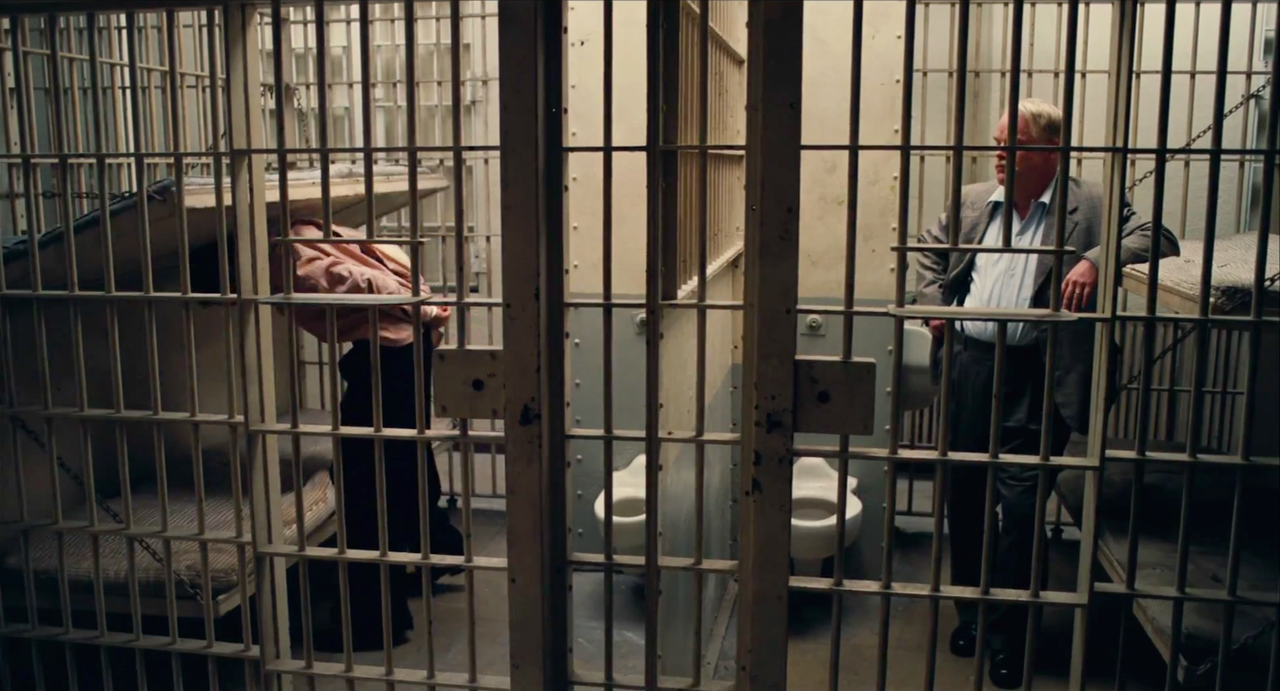

A tough film to include since I think it ultimately falls away, and apart. However, it was engrossing and hypnotic.  The 70MM print I watched left me with indelible cinematic memories.  Joaquin Phoenix's Freddie Quell may go down as a great movie character.  If only Hoffman's Lancaster Dodd was more equally realized.


7. The Queen of Versailles


Though the last third lags a bit, this whirlwind ride down the financial collapse of 2008 is almost a perfect farcical creation.  The larger than life characters, trying to keep the lights on and the dog poop off the carpet of their mansion, are so warped that they become a funhouse mirrors into which we cry at our own distorted reflections.


8. 21 Jump Street


All right.  This was a very funny movie.  It dispensed with the usual re-make/sendup strategy and tried to make us laugh on its own terms.  The best part was that almost every single actor in it, even some well-placed cameo players, seemed to get what was happening.


9. Silver Linings Playbook


When was the last time you saw Robert Deniro as vulnerable as he is in this film?  A rediscovery of his immense talent is just one of the joys of this romantic comedy by way of recovery melodrama.  It is an odd hybrid for sure, but David O. Russell just about manages to pulls off with heart, pain and only a modicum of the schmaltz and pretension that accompanies similar efforts.

10. A Separation


I admit, it is a bit of a cheat on my list, A Separation was released at the very end of 2011 in the U.S., so most of us didn't see it until 2012.  However, it is, quite simply, as good as you have heard it to be.

14 August 2012

Spellbound (1945) - Let My Love Open the Door


Doors abound in Alfred Hitchcock's Spellbound. 

This 1945 thriller is a combination of the man-on-the run-story, which Hitchcock continually worked on perfecting, and the man-chasing-himself -without-knowing-it story.

Gregory Peck plays a man caught impersonating a noted doctor who has recently disappeared.  Once exposed, he claims to have amnesia and demonstrates the symptoms of a man with a deeply repressed trauma.  Ingrid Bergman plays the psychiatrist who tries to help Peck figure out who he really was, and, more importantly, why he insists on believing he murdered somebody.

Apparently, producer David O Selznick was very taken with the practice of psychotherapy and took a very personal interest in the project. The opening credits boast an expert advisor for the psychiatric elements of the plot.  A title card informs us that in the process of psychotherapy, "the analyst seeks only to induce the patient to talk about his hidden problems, to open the locked doors of his mind."

The film latches onto this like a man with a hammer.  The symbol of doors, closed and open, is bluntly wielded at times, but there are few more subtle uses that contribute to some of the film's best moments.   

Spellbound is most often remembered for its dream sequences, which were designed by Salvador Dali. There is a central dream landscape which contains clues to the murder mystery at the heart of the film. This dream sequence was supposed to be about 20 minutes worth of footage, but the finished film only features a couple of minutes what was intended.

One dream-like sequence, (I'm not sure if is a Dali concept,) placed early in the film, is composed of  a long hallway with doors opening endlessly. This image dissolves into the two leads embracing.


However, just prior to this moment, Hitchcock uses doors to frame Bergman and Peck as she comes to his room in order to find out more about him.  Bergman approaches Peck's door from the stairs.  From her point of view we can see the light spilling at the threshold, telling her that he is still awake.


She at first avoids the door, but then enters unannounced to find him awake in his bedroom, obviously troubled.  She remains standing in the study, and they begin to talk through an open doorway.  Hitchcock creates an uneasiness, coupled with an anxiety of discovery, by using carefully directed eye lines along with framing the scene using the doorway itself.  At an important moment, when Peck approaches Bergman, nearing the doorway, he even passes through a shadow.


Once he has completely entered the room with Bergman, his gaze shifts slightly. He is now looking directly at the camera, at us.  The result is hypnotic and signals that Bergman's trip down the twisting hallways of the troubled mind is about to begin.


Unfortunately, though Spellbound has its moments of suspense, it is bogged down by  intrusive explanations of psychotherapy.  Peck and Bergman are able to generate some great chemistry as tortured and tentative lovers, and there are a few nice visual elements, but there is not much else going for this minor Hitchcock film.

12 August 2012

Shadow of Doubt - Alfred Hitchcock - Homewrecker


Uncle Charlie always knows where the back stairs are located.  He's bright, outgoing, handsome and witty; one could never imagine him shying away from a conversation in public. However, he has a tendency to disappear out a window or a fire escape just when people are looking for him. 

Charlie's niece, and his namesake, begins to favor the back stairs as well. She wants to avoid her visiting Uncle Charlie who is always patrolling the parlor or dining room of her family's home, a two-story house with a nice lawn and quirky neighbors.  When she ambles up the front walk, there he is, guarding the front porch in his light-colored suit, smoking his cigar.  The wooden steps around the back of the house become her preferred entrance and egress.  

The two Charlies play out this sinister game amidst a sunny, but drab suburban setting.  Just the way Alfred Hitchcock likes it.  

In Saboteur, the film Hitchcock made before Shadow of a Doubt, the entire expanse of America was made claustrophobic.  Here, the suspense is telescoped to a pleasant neighborhood in Santa Rosa, and, eventually,  the family house itself becomes a prison.  The aforementioned back stairs, the garage and the dining room all transform into possible traps.

This situation is quite different from the original daydreams of the heroine, Charlotte Newton (Charlie, to her friends and family), when she conjures a visit from her mother's worldly, bachelor brother, Charlie Oakley.

Charlotte is bored in her safe little community and she has her well-travelled Uncle on her mind when, almost magically, she receives a telegram informing her that Uncle Charlie is on his way to stay with them for a while!   Her elation is infectious as she walks down the street, beaming and chanting, "I knew he'd hear me." 

Hitchcock literally dissolves this very innocent and youthful moment into the oncoming force of a locomotive, the train carrying the wayward Charles Oakley.  


He takes the young Charlie's bedroom for his stay at the family house, while young Charlie moves in temporarily with her much younger sister.  This displacement of the young woman grows as she learns more about her Uncle and his strange finances and idiosyncrasies - he always carries large amounts of cash and he doesn't like his picture being taken. 

Soon, some reporters arrive to do a story on the Newton family.  But are they really reporters?  Uncle Charlie seems very wary of them and when one of them snaps his photo, he insists on them surrendering the film. 

Uncle Charlie transforms from a charming bachelor, to an odd duck ,to a dark presence as the visit from the "outside" world that young Charlie so longed for takes up residence with more baggage than she ever anticipated.  Their boring household is now unsafe as the young Charlie learns a terrible secret about Charles Oakley. In fact, she literally has to watch her step - did those boards that tripped her come loose on their own?   
Hitchcock seemed to have found a very good collaborator in screenwriter Thorton Wilder.  Wilder's Pulitzer-Prize-winning play Our Town almost invented the idea of death lurking behind the ideal image of small town America. 

In the young Charlie of Shadow of a Doubt, one can see a bit of Emily Webb, the heroine of Our Town, who is cautious about marriage.  Indeed, when Charlie begins to receive the serious romantic attention of one of the "reporters" who seem hot on Uncle Charlie's trail, she is flattered, but halting.  The enormity of societal existence is being laid out to her very rapidly.  Life, marriage, money and death are all explained in cynical sermons by her Uncle, who intones:

"The cities are full of women, middle-aged widows, husbands, dead, husbands who've spent their lives making fortunes, working and working. And then they die and leave their money to their wives, their silly wives. And what do the wives do, these useless women? You see them in the hotels, the best hotels, every day by the thousands, drinking the money, eating the money, losing the money at bridge, playing all day and all night, smelling of money, proud of their jewelry but of nothing else, horrible, faded, fat, greedy women... Are they human or are they fat, wheezing animals, hmm? And what happens to animals when they get too fat and too old?"

This is quite a strain for the young Charlie as she finds herself desperately trying to avoid her Uncle, The house becomes strange to her, and ultimately dangerous.   For instance, she shares an intimate  moment of romantic revelation in the house's garage, only to later find the same location is a deadly snare.


It is not news to anybody that Hitchcock got a great amount of joy in pushing these macabre ideas to almost perverted ends.  His camera seems to take strange pleasure in robbing Young Charlie of her innocence.  He lingers on her broken spirit as she realizes evil in the world can survive and thrive, even in the knowledge and view of the righteous.  She sees evil, but can do nothing about it.

In a final toast, and a tender moment with his sister, Uncle Charlie reveals the secret he has learned, that the instinct to preserve the idea of  "home" and  "family", and by extension community, can provide cover for sinister doings. 

Shadow of a Doubt moves Hitchcock a little further into the psychology of domestic life being invaded and taken advantage of by sinister forces.  Rebecca and Suspiscion had already probed the infestation of marriage by psychopathic and cynical agents, but Shadow simultaneously expands this vision and turns it inward.  

27 June 2012

Movie Shot of the Week - Fantomas (1913)


19 June 2012

Movie Shot of the Week - The Fall (2010)


10 May 2012

The Cabin In The Woods - Review - Office Space Meets Evil Dead?


Who's watching? 


More than most films, when reviewing The Cabin in the Woods, the first question one asks is how closely one must hew to the guidelines set out by the film's creators.  

It is probably not news that producer Joss Whedon (Buffy the Vampire Slayer, The Avengers) and director Drew Goddard (Cloverfield) have implored critics, podcasters and audience members to try their best not to spoil the many twists and turns that they have baked into their thriller satire.  

Reviewers have approached this request with at least a modicum of  respect, excepting a few tongue-in-cheek attempts at humor.  For example, the Village Voice review should only be read by somebody who has seen the film, because it gives away the ending in the first sentence!

In the end though, Whedon and Goddard's much publicized entreaty for radio silence is strangely misplaced.  For The Cabin in the Woods is not really constructed as a whiplash inducing plot twister.  Indeed, if you are looking for that floor-dropping-out-from-under-you feeling induced by such mind-benders as The Sixth Sense, The Usual Suspects or The Matrix, you may be very, very disappointed.

Rather than a brain teaser, or labyrinthine philosophical puzzle, this masquerading horror film is actually more akin to an open-ended mid-term question that students are expected to elaborate on at length in blue books that will never be cracked by the professor.

Let's start at the beginning of the syllabus though.   The titular abode in the forest is the destination of five college friends seeking to blow off steam on a long weekend, but, right away, you sense that not all of them will be coming back. 

If you think you've seen this movie before, that's the point!  

Like Wes Craven's franchise engendering, genre-prodding Scream, Whedon and company know you've seen it all before and they aren't even going to try to pretend you haven't.  Almost everything in the opening sequences of the college romp into the deep woods is by the numbers...only it isn't.

The young, attractive cast of stereotypical slasher prey display some strange divergences from the norm in these pictures.  Chris Hemsworth's jock archetype, for instance, has a deep knowledge of economic theory and the stoner character, played with great aplomb by Franz Kranz, has a pretty rational and lucid handle on the increasingly weird situation in which the crew finds themselves.

Also, there is that creepy cabin, the road to which runs by an abandoned gas station, naturally attended by a sun-wrinkled, grouchy red neck who warns the students of the dangers ahead.  This harbinger of doom seems to be plucked right from central casting and the cabin seems constructed from the same wood as the forest cottage in Sam Raimi's ground-breaking film The Evil Dead. This all seems so perfect that we aren't scared as much as we are amused.

 Once the kids arrive at their destination a nice sequence unfolds.  One of the men discovers, behind a rather gruesome painting, a two way mirror that allows him to see into the adjoining room of one of the sexy coeds.  However, the scene doesn't go as we are expecting, and indeed it flips our expectations. Who is watching whom? Why would we watch?  Do we have the power to look away? 

However, we have already been tipped off to these questions and themes through the introduction of a completely different set of characters.  And here's where that spoiler question I talked about comes into play.  

Trying to honor the filmmakers as best I can, I'll just briefly explain that within the first few minutes, as we are getting to know these young lambs heading to the horror movie slaughter, we are also introduced to two bureaucratic engineer-types operating at some vast-Pentagon-like war room. Portrayed humorously by Bradley Whitford and Richard Jenkins complete with ties and white, short-short sleeve shirts these two seem to have wandered in from Mike Judge's workplace satire Office Space.  

"Somebody has a case of the Mondays!"


From the start, Cabin in the Woods is about the interplay of these two worlds and my guess is the filmmakers were relying on our continued interest in exactly how these worlds connect to buoy their experiment.  Unfortunately,  too many cats are let out of the bag too early.  We're ahead of the movie a bit through most of its running time, and, after a while, I got a little impatient waiting for these two worlds to intersect. It does happen, but it is very late in the game.

The collision of these two story lines unleashes a frenetic orgy of non-stop horror jokiness that is so blood- drenched that you can't help but giggle with delight at the pure audacity of it. However, I also couldn't help but think that it was overcompensating for the film's flimsy and slightly boring middle section.  

The Cabin in the Woods is amusing enough and has its moments that illuminate its themes brilliantly, but without showing a real flair for horror, or for conspiracy, we are left with bald satire that doesn't really have a strong enough spine. 

Some great filmmakers have tried to twist genres inside out with more successful results artistically.  Stanley Kubrick's The Shining and his thriller take Eyes Wide Shut are an example.  And Michael Haneke subverted the expectations of the horror genre with his movie Funny Games. 

It doesn't appear that Whedon and Goddard are attempting the same sort of experiments that Kubrick and Haneke did, and their movie is a lot of fun despite that, but I found myself wishing they had tried a little harder.  

I will give them this though, they really go for broke with the ending of this movie, and, while not a real twist, it is delightfully subversive. 

And unlike that Village Voice reviewer, I'll keep it confidential!

19 April 2012

Movie Posters - Invasion of the Bee Girls