19 January 2015

Coverage - What I've Been Watching

Snowpiercer


I missed the party, or, I guess, the train on this one. Currently hovering at over 90% on Rotten Tomatoes and on many critics Top Ten lists for 2014, this dystopian sci-fi action thriller slows down the further up the train its rebel dregs of society get. The filmmaker doesn't seem to know what do as the rag-tag group advances, so the movie starts stretching out action sequences and recycling well-worn tropes of the many genres it is pulling into its orbit. All the actors, especially Tilda Swinton seem game for the ride, but the film never gets back on track after she departs.

Coherence


In the spirit of Primer and the under-seen mind-bender Triangle, this low budget ensemble piece starts as a mumblecore-type dinner party movie, like we've seen a hundred times in the past eight years. However, a passing comet starts to affect the guests in strange ways. Very interesting through most of its running time, it also sticks the landing better than many other films of its type.

In Fear
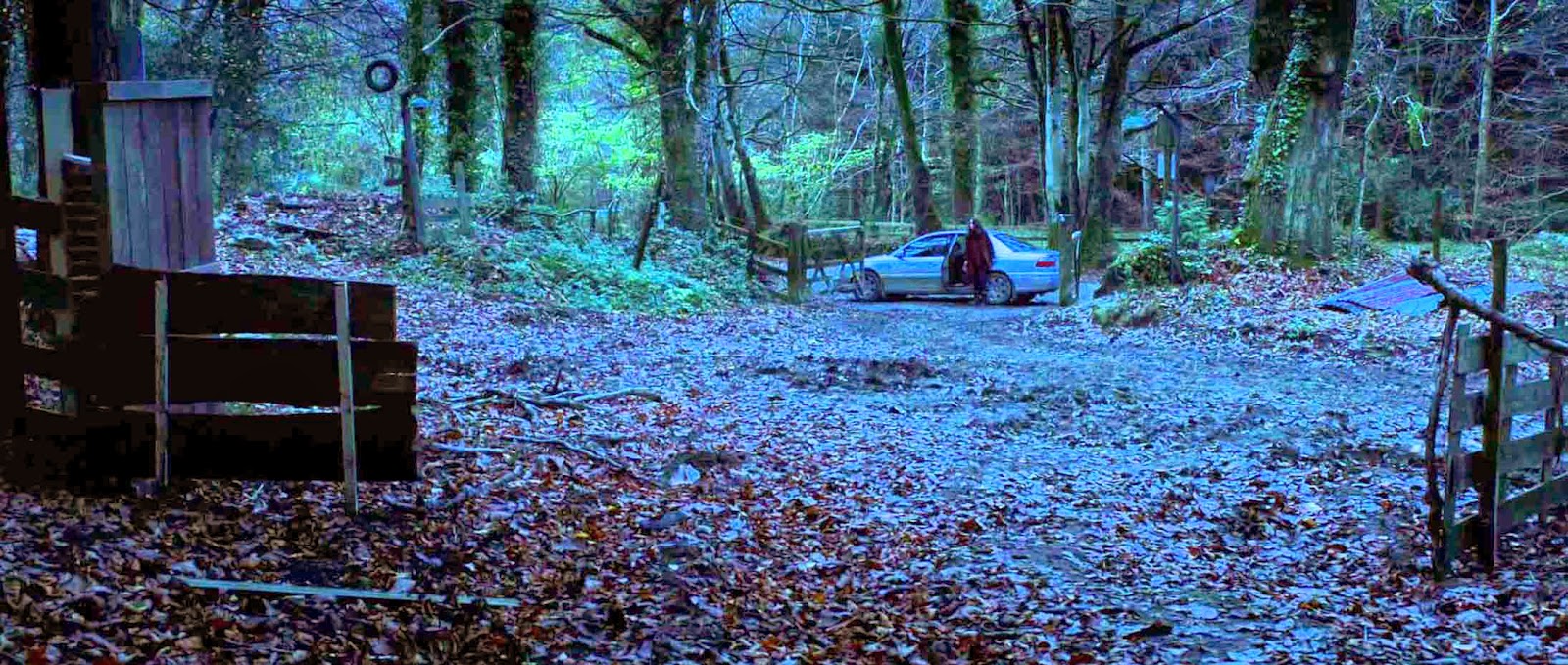


The desolate English countryside and the narrow, tree-lined woods, through which this couple have to navigate as night falls and strange events begin to happen, is the best character. The atmosphere is creepy and the maze of trails get more tight and claustrophobic, but the film falters as it runs into its second half, only temporarily picking up a little jolt from the performance of an added character with a twisted smile and a glint in his eye.  Once the usual climactic beats kick in, the film gets less and less interesting.

The Babadook


The Babadook promises a lot with its slow buildup and its gambit of saddling the protaganist, a widowed single mother, with a kid prone to flights of maddening screaming or fits. Essie Davis, in a bravura performance that leaves everything on the table, screams at the child, "why can't you just be normal!" We feel for her, deeply. While the introduction of a sinister, Edward Gorey type pop-up book fills the dark corners of our mind with horrifying possibilities, the film abandons this innovation to give us warmed over homages to moments from other horror classics, almost like ticking off boxes: The Exorcist, The Shining, Nightmare on Elm Street, The Grudge, etc. It becomes apparent that the filmmaker is less interested in making a truly terrifying film, and more insistent on making sure that we get the deeper meaning, that we know that we're not just getting a horror flick, but a story with themes. As a harrowing story of the closed world of a damaged mother and son, the movie is solid. There are genuine creepy moments and some interesting sequences, but don't come for The Babadook, instead this is Essie Davis's film from the first frame. Her performance leaves nothing behind and she commits to every single moment.

The Unknown Known


Errol Morris is a national treasure, and this interview, his second with a U.S. Secretary of Defense who presided over a complicated quagmire of war, is a fascinating chase down a rabbit hole of beauracratic thinking gone wild. Morris and Rumsfeld are actually quite well matched, and Rumsfeld comes off as an amazing performance artist, who has perfected his bit so well that he long ago bought completely into it. I'm not sure you could create a better fictional character to represent the military industrial complex of the Iraq War era. Danny Elfman's score is odd and distracting at points.


09 June 2014

Movie Shot of the Week - M.A.S.H. (1970)

24 May 2014

Godzilla (2014) - Review


Very late in the newest entry in the Godzilla franchise, the giant titular lizard has leveled half of San Francisco, but finds himself only halfway to his goal of defeating his enemies.   His massive frame, supported by two impossibly large legs, slumps, and his shoulders droop into a fatigued sigh. It's as if he’s moaning, “ whew, how much more of this?"


"I know how you feel, big guy," I wanted to shout at the screen.  

This monster action movie takes a long time to get the monsters and then lays on a lot of action  late in the game. 

The good news is that moviegoers who have an intense interest in seeing the old fashioned Godzilla fully realized through the best of modern cinematic technology will come away satisfied. The bad news is that anybody looking for almost anything else will most likely walk away shrugging. 

The original Godzilla film, made in 1954, was birthed in direct response to incidents involving nuclear weaponry and its effects on the Japanese people.   In director Gareth Edwards new re-imagining, the premise, involving Japanese nuclear reactors, admittedly brings up the shadow of the recent Fukishima disaster, but is tossed into the narrative with less care than a ripped-from-the-headlines Law and Order episode.    

Bryan Cranston, fresh off his artistic triumph as Walter White in AMC's series Breaking Bad plays a nuclear scientist living in Japan and running a power plant with his wife played by Juliette Binoche.  Steadily ncreasing tremors trigger a full meltdown and disaster at the plant, but when we flash 15 years forward, it seems that the disaster may have been something else entirely. Cranston's scientist, now a loner and estranged from his only son, is sure that the government, which still keeps a strict quarantine on the area is lying to the public about what really happened.  

Guess what? They are! And, like all government operations in these disaster monster movies, there are tens of thousands of personnel involved in these top secret machinations. As these things usually go, the experiments conducted get out of control fast, and soon there is a prehistoric creature on the loose, and it feeds on nuclear material!  This flat-headed, winged creature seems to be a nod to another famous Japanese monster creation Rodan, and it turns out that it isn't alone!   

You might notice that in my summation of the plot so far I haven't even mentioned Godzilla. Exactly!  Most of the movie's first half is establishing Godzilla's antagonists, which the U.S. military, in its inimitable fashion, names the M.U.T.O.'s (Massive Unidentified Terrestrial Organisms.) In truth, the military doesn't seem very perturbed. In fact, everybody is pretty calm about this impending titanic clash between a couple of mating MUTOS and now-wakened Godzilla, who seems, for some reason,  incredibly intent on locking horns with these creatures.

Apparently, Godzilla has risen from the depths in response to the presence of the MUTO's , seeing them as worthy prey for his apex predator tastes.  This is all according to a pair of scientists; both are played by the way overqualified duo of Ken Wantanabe and  Sally Hawkins. They explain everything with about as much excitement as the military does. Everything is so matter-of-fact in this film that it is hard for any suspense to materialize. 

In trying to follow the classic formula of indirectly revealing the monster over time, a technique popularized by Steven Spielberg's Jaws, the film is infused with aimlessness that even the spectacular destruction of two major U.S. cities can't redeem. I will admit that the filmmaker does get off a shot of genuine irony when Godzilla finally appears full bodied on screen.
   
Ken Wantanbe's scientist and David Straithern's Admiral
wait around some more.
But, mostly, we wait.  This is a film in which main characters spend a good amount of time on a Navy ship, following Godzilla's huge spiked back as it cuts a wake at a comfortable speed through the Pacific.  One exception is a suspenseful nighttime mission where two soldiers are trying to evade a lurking MUTO while they maneuver on a high railroad trestle. 

Back to the good news, though. Godzilla looks great and moves, well, like a guy in big rubber suit, and I mean that in the best way possible. When the gigantic, and I mean gigantic, reptile is pushing the MUTOs around the city, he seems like a live wrestling bear rather than some sleek CGI creation . He really is a great technical achievement.  It is pretty thrilling to see the infamous Godzilla roar send ripples through his neck muscles. The MUTOs, on the other hand,  look more like the standard issue creatures that seem to inhabit summer blockbusters over the last five or six years, although I do like the way they crack open nuclear missiles and chug the radiation inside like they were a  downing a Red Bull.

All of this technical magic comes later in the movie, (which isn't really that unusual for a monster film,) but what is unusual is the way the human stories are treated so perfunctorily.  Director Gareth Edwards made a small stir with his indie film Monsters back in 2010.  In that film, the creatures also take their time revealing themselves, but there was much more suspense built through the growing connection between the two human protagonists, so that when all hell cuts loose, we're on the edge of our seat.


While Godzilla cuts a fine 3D figure in this updated version, he couldn't care less about the humans underfoot. Now,  that can be excused for a 300 foot prehistoric apex predator, but I’m not sure filmmakers should get the same pass.

26 February 2013

Movie Posters - Oh, Heavenly Dog! (1980)


Chevy Chase shares billing with Benji.   As a bonus, down at the bottom, above the PG rating, are the following sentences that create a bizarre juxtaposition:


1. "Read the Scholastic Paperback"
2. "See Benji as the August Playgirl Centerfold"

Those were the days, huh?

03 January 2013

10 Best Movies of 2012

This year, I decided to try my hand at making a list of what I thought were the best films of the year. I tried to limit myself, as most critics do, to movies screened or released in 2012. I also tried to limit the list to films I saw in theaters.

I haven't seen some films (Zero Dark Thirty, Django Unchained, etc.) that appear on many other end of year lists.  However, I also have seen most of the films (Lincoln, etc.) that appear on those lists, but do not appear on mine.

Here is my Ten Best of 2012.

1. The Imposter


I can't remember the last time I watched a movie with so much of my time spent thinking, "No. No, it can't be. What? Oh, my god." It also contains one of the most incredible criminals every put on film.  If he was a fictional creation, you wouldn't buy him.


2. The List


A fascinating documentary about an interesting hero.  He has dedicated his life to saving from retribution the Iraqi's who helped coalition forces during the Iraq war.  Even with generals and politicians behind his crusade, the wheels of bureaucracy threaten to grind his righteous mission into dust.


3. Headhunters


Over the course of this brisk Norwegian thriller, you will laugh, cringe and shriek at the gathering misfortune of an arrogant art thief.  He is the kind of character you would usually hate in another movie, but from the very opening words and images, he won me over with his unusual predicament, which only gets worse.


4. The World Before Her


The filmmakers follow two contrasting training programs : The preparation for the televised Miss India pageant and the boot camp style indoctrination of the young girls of a radical religious/political movement. If the two forces currently battling for global supremacy are celebrity entertainment culture and militant conservative religiousness, then I can't think of movie that better juxtaposes and examines the two.


5. Argo

This movie is labeled by many as a thriller, but it is actually a heist movie.  Affleck's direction is pretty marvelous and doesn't call attention to itself. I was gripped throughout, even during the over-the-top, apparently embellished ending of this real life tale, despite, I hate to say this, Affleck's miscasting of himself in the lead.


6. The Master


A tough film to include since I think it ultimately falls away, and apart. However, it was engrossing and hypnotic.  The 70MM print I watched left me with indelible cinematic memories.  Joaquin Phoenix's Freddie Quell may go down as a great movie character.  If only Hoffman's Lancaster Dodd was more equally realized.


7. The Queen of Versailles


Though the last third lags a bit, this whirlwind ride down the financial collapse of 2008 is almost a perfect farcical creation.  The larger than life characters, trying to keep the lights on and the dog poop off the carpet of their mansion, are so warped that they become a funhouse mirrors into which we cry at our own distorted reflections.


8. 21 Jump Street


All right.  This was a very funny movie.  It dispensed with the usual re-make/sendup strategy and tried to make us laugh on its own terms.  The best part was that almost every single actor in it, even some well-placed cameo players, seemed to get what was happening.


9. Silver Linings Playbook


When was the last time you saw Robert Deniro as vulnerable as he is in this film?  A rediscovery of his immense talent is just one of the joys of this romantic comedy by way of recovery melodrama.  It is an odd hybrid for sure, but David O. Russell just about manages to pulls off with heart, pain and only a modicum of the schmaltz and pretension that accompanies similar efforts.

10. A Separation


I admit, it is a bit of a cheat on my list, A Separation was released at the very end of 2011 in the U.S., so most of us didn't see it until 2012.  However, it is, quite simply, as good as you have heard it to be.

14 August 2012

Spellbound (1945) - Let My Love Open the Door


Doors abound in Alfred Hitchcock's Spellbound. 

This 1945 thriller is a combination of the man-on-the run-story, which Hitchcock continually worked on perfecting, and the man-chasing-himself -without-knowing-it story.

Gregory Peck plays a man caught impersonating a noted doctor who has recently disappeared.  Once exposed, he claims to have amnesia and demonstrates the symptoms of a man with a deeply repressed trauma.  Ingrid Bergman plays the psychiatrist who tries to help Peck figure out who he really was, and, more importantly, why he insists on believing he murdered somebody.

Apparently, producer David O Selznick was very taken with the practice of psychotherapy and took a very personal interest in the project. The opening credits boast an expert advisor for the psychiatric elements of the plot.  A title card informs us that in the process of psychotherapy, "the analyst seeks only to induce the patient to talk about his hidden problems, to open the locked doors of his mind."

The film latches onto this like a man with a hammer.  The symbol of doors, closed and open, is bluntly wielded at times, but there are few more subtle uses that contribute to some of the film's best moments.   

Spellbound is most often remembered for its dream sequences, which were designed by Salvador Dali. There is a central dream landscape which contains clues to the murder mystery at the heart of the film. This dream sequence was supposed to be about 20 minutes worth of footage, but the finished film only features a couple of minutes what was intended.

One dream-like sequence, (I'm not sure if is a Dali concept,) placed early in the film, is composed of  a long hallway with doors opening endlessly. This image dissolves into the two leads embracing.


However, just prior to this moment, Hitchcock uses doors to frame Bergman and Peck as she comes to his room in order to find out more about him.  Bergman approaches Peck's door from the stairs.  From her point of view we can see the light spilling at the threshold, telling her that he is still awake.


She at first avoids the door, but then enters unannounced to find him awake in his bedroom, obviously troubled.  She remains standing in the study, and they begin to talk through an open doorway.  Hitchcock creates an uneasiness, coupled with an anxiety of discovery, by using carefully directed eye lines along with framing the scene using the doorway itself.  At an important moment, when Peck approaches Bergman, nearing the doorway, he even passes through a shadow.


Once he has completely entered the room with Bergman, his gaze shifts slightly. He is now looking directly at the camera, at us.  The result is hypnotic and signals that Bergman's trip down the twisting hallways of the troubled mind is about to begin.


Unfortunately, though Spellbound has its moments of suspense, it is bogged down by  intrusive explanations of psychotherapy.  Peck and Bergman are able to generate some great chemistry as tortured and tentative lovers, and there are a few nice visual elements, but there is not much else going for this minor Hitchcock film.

12 August 2012

Shadow of Doubt - Alfred Hitchcock - Homewrecker


Uncle Charlie always knows where the back stairs are located.  He's bright, outgoing, handsome and witty; one could never imagine him shying away from a conversation in public. However, he has a tendency to disappear out a window or a fire escape just when people are looking for him. 

Charlie's niece, and his namesake, begins to favor the back stairs as well. She wants to avoid her visiting Uncle Charlie who is always patrolling the parlor or dining room of her family's home, a two-story house with a nice lawn and quirky neighbors.  When she ambles up the front walk, there he is, guarding the front porch in his light-colored suit, smoking his cigar.  The wooden steps around the back of the house become her preferred entrance and egress.  

The two Charlies play out this sinister game amidst a sunny, but drab suburban setting.  Just the way Alfred Hitchcock likes it.  

In Saboteur, the film Hitchcock made before Shadow of a Doubt, the entire expanse of America was made claustrophobic.  Here, the suspense is telescoped to a pleasant neighborhood in Santa Rosa, and, eventually,  the family house itself becomes a prison.  The aforementioned back stairs, the garage and the dining room all transform into possible traps.

This situation is quite different from the original daydreams of the heroine, Charlotte Newton (Charlie, to her friends and family), when she conjures a visit from her mother's worldly, bachelor brother, Charlie Oakley.

Charlotte is bored in her safe little community and she has her well-travelled Uncle on her mind when, almost magically, she receives a telegram informing her that Uncle Charlie is on his way to stay with them for a while!   Her elation is infectious as she walks down the street, beaming and chanting, "I knew he'd hear me." 

Hitchcock literally dissolves this very innocent and youthful moment into the oncoming force of a locomotive, the train carrying the wayward Charles Oakley.  


He takes the young Charlie's bedroom for his stay at the family house, while young Charlie moves in temporarily with her much younger sister.  This displacement of the young woman grows as she learns more about her Uncle and his strange finances and idiosyncrasies - he always carries large amounts of cash and he doesn't like his picture being taken. 

Soon, some reporters arrive to do a story on the Newton family.  But are they really reporters?  Uncle Charlie seems very wary of them and when one of them snaps his photo, he insists on them surrendering the film. 

Uncle Charlie transforms from a charming bachelor, to an odd duck ,to a dark presence as the visit from the "outside" world that young Charlie so longed for takes up residence with more baggage than she ever anticipated.  Their boring household is now unsafe as the young Charlie learns a terrible secret about Charles Oakley. In fact, she literally has to watch her step - did those boards that tripped her come loose on their own?   
Hitchcock seemed to have found a very good collaborator in screenwriter Thorton Wilder.  Wilder's Pulitzer-Prize-winning play Our Town almost invented the idea of death lurking behind the ideal image of small town America. 

In the young Charlie of Shadow of a Doubt, one can see a bit of Emily Webb, the heroine of Our Town, who is cautious about marriage.  Indeed, when Charlie begins to receive the serious romantic attention of one of the "reporters" who seem hot on Uncle Charlie's trail, she is flattered, but halting.  The enormity of societal existence is being laid out to her very rapidly.  Life, marriage, money and death are all explained in cynical sermons by her Uncle, who intones:

"The cities are full of women, middle-aged widows, husbands, dead, husbands who've spent their lives making fortunes, working and working. And then they die and leave their money to their wives, their silly wives. And what do the wives do, these useless women? You see them in the hotels, the best hotels, every day by the thousands, drinking the money, eating the money, losing the money at bridge, playing all day and all night, smelling of money, proud of their jewelry but of nothing else, horrible, faded, fat, greedy women... Are they human or are they fat, wheezing animals, hmm? And what happens to animals when they get too fat and too old?"

This is quite a strain for the young Charlie as she finds herself desperately trying to avoid her Uncle, The house becomes strange to her, and ultimately dangerous.   For instance, she shares an intimate  moment of romantic revelation in the house's garage, only to later find the same location is a deadly snare.


It is not news to anybody that Hitchcock got a great amount of joy in pushing these macabre ideas to almost perverted ends.  His camera seems to take strange pleasure in robbing Young Charlie of her innocence.  He lingers on her broken spirit as she realizes evil in the world can survive and thrive, even in the knowledge and view of the righteous.  She sees evil, but can do nothing about it.

In a final toast, and a tender moment with his sister, Uncle Charlie reveals the secret he has learned, that the instinct to preserve the idea of  "home" and  "family", and by extension community, can provide cover for sinister doings. 

Shadow of a Doubt moves Hitchcock a little further into the psychology of domestic life being invaded and taken advantage of by sinister forces.  Rebecca and Suspiscion had already probed the infestation of marriage by psychopathic and cynical agents, but Shadow simultaneously expands this vision and turns it inward.